Friday, November 10

Labeling The World

The dictionary defines a label as something functioning as a means of identification. It's also how we learn to process cognitive information. But labels can also be tricky as the definition of any specific identification is a matter of perception.

In communication, we generally use the term ''message'' over ''label'' because when the terms are applied to people and companies, "label" tends to have a negative connotation. "Message" does not.

The interesting thing about messages is that they come from a variety of sources, not just the individual or company. Generally, messages about individuals and companies come from everything they communicate about themselves (written or spoken), everything they communicate about others (comparisons or contrasts), everything others say about them (real or perceived, right or wrong), and everything others say about themselves (comparisons or contrasts).

Given that it requires about 80 impressions (the amount of times you're exposed to a message), the message that prevails most often is usually the one repeated most frequently from multiple sources with differing degrees of credibility, including the individual or company.

Wee Shu Min, who continues to be a topic of choice in the blogsphere, learned this the hard way. She defined herself as elite, without recognizing that most people do not know that ''elite'' and ''elitism'' are not necessarily the same things as pointed out by one blogger. A member of the 'elite' could be a philanthropist (a person who donates money, goods, time, or effort to support a charitable cause) as much as they might be a snob (a person who adopts the world view that other people are inherently inferior). Ironically, the label she chose stuck, along with its worst possible meaning. When in reality, what she meant was that she had little sympathy for people who do not empower themselves (a view that is contrary to the view of a snob).

Derek Wee, on the other hand, defined himself as a solitary voice speaking out for underprivileged masses against an uncaring government, which is a rather noble message whether it was, in fact, true or not. (Mr. Wee is a very well-educated professional working for a multinational corporation, which may or may not qualify him as underprivileged). Ironically, the label he chose stuck too, along with its best possible meaning. Enough so that I've seen graphic representations of Derek Wee as someone who could only afford to eat a meager bowl of rice, alone, in the dark (just before he turns on his computer to blog).

Both employed messages or ''labeled'' themselves, creating a ''perception'' of themselves in the blogsphere, which is what shaped the entire story. In reality, both could be very different from their blog posts, but for millions of people one is a snob and one is a hero. (I've posted my observations on the story in two earlier posts: Correcting For Politics and Sanitizing Personal Opinion. Unless, more people come to realize both were right in that one voice is a statement while two voices is discussion.

I'm not sure they will. Most people seem more interested in discussing the labels, which is why we must always take care in defining ourselves through both actions and words, else we allow others define us.

It is one of the things we do here. Help people or groups of people (or companies, which are made up of groups of people) define and communicate their message while they avoid being mislabeled by others. Seems simple, until you pick up the newspaper, see a competitor's advertisement, hear another's sales pitch, or, in the case of Wee Shu Min or Derek Wee, read someone else's blog.

However, outisde of communication, individuals and businesses hoping to share a message or children learning to process information for the first time, we don't need labels. But what the bleep do we know.


Wednesday, November 8

Winning A State Seat


I've posted before about the last minute, unfounded scandal that nearly cost Jim Gibbons an election. Fortunately, Gibbons won 48 percent of the vote to Dina Titus' 44 percent and will be Nevada's next governor.

As the numbers came in, you could see the true impact of the Gibbons-Mazzeo 'scandal.' Early voting numbers (early voting took place while the scandal was unfolding) were skewed toward Titus while the general election numbers skewed toward Gibbons. The difference? Conspiracy theories aside, surveillance tapes showed Gibbons was never in the parking garage where Mazzeo said he assaulted her.

The numbers also show perception's impact on reality. Fortunately for Gibbons, his message, combined with the truth, corrected what could have been a disastrous evening for him and his team.

For our small part, we were thrilled to work with some great people within the Nevada Republican party on a few Victory 2006 pieces. We're glad they assisted Gibbons and Brian Krolicki in turning in wins, not because of politics, but because they will be great assets to the state of Nevada.

Friday, November 3

Recognizing Political Spin

Thomas Friedman demonstrated a classic example of political spin with his op-ed column in The New York Times on Nov. 3, “Insulting Our Troops, and Our Intelligence" by turning John Kerry's mangled quote into a George Bush administration criticism.

For those that missed it, John Kerry said “You know, education, if you make the most of it, if you study hard and you do your homework, and you make an effort to be smart, uh, you, you can do well. If you don't, you get stuck in Iraq."

Many people, especially those in uniform, were offended by the statement because it basically implies our troops represent a less educated portion of the population (which is why they join the military). Nothing could be further than the truth. In fact, we very likely have the best educated military today than we have had in the entire history of the United States. These are smart men and women, many of whom graduated at or near the top of their high school classes, many of whom have advanced degrees, and many of whom will go on to earn advanced degrees once their enlistment ends. Several of them are my friends.

Not surprisingly, the Bush administration, with Republicans facing a heated election year, were quick to correct Kerry's misstatement, defending our troops, regardless of where they may be stationed, and shifting the topic of the day from select Republican missteps into select Democrat missteps. Today, Friedman managed to eke out a full reversal with his op-ed piece, somehow making Kerry's political gaffe a Bush administration responsibility. Sadly, because the op-ed piece appears in The New York Times, some people will give it more credit than what it is: an opinion piece.

Politics aside, and not considering my own feelings about Iraq, this is what is known as a political spin: shifting a political flashpoint to another topic, preferably one that puts your opponent in a bad light. Some people are good at it. Friedman is very good at it. And at the end of the day, you have to ask yourself: doesn't anyone want to discuss what's best for America anymore, without polarizing everything from political issues to personal assessments?

Wednesday, November 1

Changing Las Vegas


The Stardust Hotel and Casino, which has been in business since 1958, will close today. It will be torn down to make way for a $4 billion casino resort center called Echelon Place. It's one of many changes that have been sweeping southern Nevada for decades, nothing new for a city that preserves few historic properties, preferring to erase the past to make way for progress.

The less reported but perhaps equally compelling prospects can be seen in the community. In 1994, I wrote the first cover story for Las Vegas Magazine, which predicted many of the residential development changes that southern Nevadans are now seeing come to fruition.

At the time, then vice president in charge of market analysis for PriMerit, Patrick Egger, forecasted steady growth until the Las Vegas metropolitan area reached a population of 1.8 million, when increased land costs, interest rates, taxes, infrastructure, and cost of construction would dampen the market. Currently, Clark County is projected to have 1.9 million people (2 million by Sept. of next year) and, as predicted, while growth continues, it has slowed.

Eggers wasn't the only one to make reasonably accurate predictions. Lot shrinkage, Z lots (angled lots), 3-story homes, townhomes, condos, and mini master plans (as opposed to the major developments such as Summerlin and Green Valley, which broke ground in the 1990's) were all discussed in that article. And all of them have become common among newer developments in Las Vegas, leaving some people to wonder what might be next.

Perhaps because Copywrite, Ink. works with so many companies in diverse industries (in market and out of market), we often see a mixed bag of snapshots for the future of southern Nevada. While not all of it is as good as some people like to think, there are some promising prospects for this once tony dusty tourist town. Some of them aren't even found in the valley.

On Monday, I was in Kingman, Arizona, working with one of our agency clients and a home developer. In the future, it is very possible Kingman, much like Pahrump to the west and Mesquite to the north, will eventually be considered an acceptable commute community for the Las Vegas metropolitan area. Perhaps even more so with the growing number of private pilots cutting commute times from 2-3 hours to 20-30 minutes, which mirrors a forecast report on aviation's role in the economic development of small communities that we did for Carter Burgess just five years ago.

If commute communities (with aviation support or not) take hold in the next decade, Las Vegas could very well shrug off its largest, though seldom talked about, disadvantage. It is an island (surrounded by desert instead of water) with limited resources. Commute communities could begin to ease the burden of infrastructure and land scarcity. If not, then growth challenges will simply become more severe (education, traffic, water, crime), tax burdens like those imposed in 2003 will likely increase (they've already dampened what was once a very positive economic outlook), and the quality of life will not improve as investors continue to dismiss cultural assets in favor of other ventures (cultural assets are usually driven by neighboring cities).

All this might all seem off topic from communication, but as a company that has operated in the area for 15 years, I thought it was fitting to consider the future of Las Vegas as another chapter closes with the doors of the Stardust.

Thursday, October 26

Controlling The Questions

Someone recently pointed out that “when you control the questions, you control the issue.” Nothing could be more true.

A few days ago, I offered comment about the Gibbons-Mazzeo 'scandal' as some people call it in a post titled Going for Gibbons. Until proven otherwise, I remain unwavering in my decision to dismiss the so-called incident even as Mazzeo, after days of coaching, emerged to hold her own press conference.

But for the purposes of communication study as it applies to the above quote, I propose flipping the issue by subjecting Mazzeo to an aggressive line of questioning that Congressman Jim Gibbons has endured over the last several days.

Why did she flirt with the congressman or, at minimum, why didn't she verbally reject such comments in the company of her friends? Why didn't she leave if she felt uncomfortable because of the unsubstantiated claim he played footies with her under the table? Why did she engage him again when she exited the establishment? Why did she allow her friends to leave her alone, if she was already uncomfortable with the congressman? Why did she agree to walk to her car with him, alone? Why didn't she re-enter the establishment and seek assistance? If she was as intoxicated as reported, why was she going to her car anyway? Would she have driven drunk? Why wasn't she given a blood test to determine her level of intoxication? Why did she refute her own testimony (that it was a misunderstanding) after being contacted by an attorney?

Suddenly, her allegations begin to evaporate. Unfortunately, those questions are not being asked enough. But as mentioned, when you control the questions, you control the issue. And right now, the questions are being controlled by the media and one of her attorneys, who happens to be active supporter of Gibbons' opponent.

Correcting For Politics

I seldom write about the same subject two posts in a row, but the Wee Shu Min story (after her father, Wee Siew Kim, apologized for his apology) continues to develop as a topical case study about political correctness. Specially, he apologized for saying "I should not have said what I did about people's inability to take the brutal truth and strong language" and reinforced that he counseled his daughter Shu Min.

In the United States, it's called political correctness (PC), though the concept is not exclusive to the English language. The term is commonly used to describe language, or behavior, which is claimed to be calculated to provide a minimum of offense, particularly to the racial, cultural, or other identity groups being described.

The "earliest cited usage of the term" is said to come from a U.S. Supreme Court decision — Chisholm v. Georgia (1793) — where it clearly means that the statement it referred to is not ''literally'' correct. However, for most Americans, the real PC movement began in late 1980's and early 1990's. By the end of the 1990's, the term was equally loathed by political conservatives and liberals alike because more often than not it hindered communication rather than enhanced it.

Part of the reason Americans began abandoning PC usage came after the push to use "gender-neutral" job titles ("lineworker" instead of "lineman," "chairperson" or "chair" instead of "chairman," etc.). Some stuck. Some did not ("maintenance hole" never really replaced "manhole"). Some, it depends on who you talk to (many female executives have insisted on being identified as chairman vs. chairperson.) And some characterizations are moving targets, most notably among people over age 55, who have been reclassified from "elder" to "elderly" to "senior" to "older adult" to "active adult" in the last few decades. In addition, ''handicapped'' became ''disabled'' became ''people with disabilities.''

Besides renaming specific groups and objects, particularly around issues of race and gender, the real movement was aimed at watering down heated political speak about social issues, as if social issues can somehow be discussed without emotion or passion. And that is the real trap Wee Siew Kim is putting himself in. As I've written before, public figures and companies are seldom judged on a crisis, but rather on how well they manage the crisis (even if it really wasn't a crisis to begin with).

In Singapore, many bloggers seem to feel that the issue, not the words, deserve discussion. But unfortunately, they are learning just as Americans (or should I say people of the United States?) continue to learn, that too much focus on semantics will always overshadow the real issues, paralyzing entire communities and countries. Analyzing the apology and demanding an apology will serve as nothing more than a distraction over the real issue. Meanwhile, nothing is done.

Certainly, this is not a popular view, not even among some fellow citizens, but a solution for Singapore borders on the obvious. As long as a society prefers capitalism over communism, which has proven ineffective as the great equalizer it was claimed to be (communistic leaders often assume exclusive privileges over the people anyway), then there will always be people who covet what other people have, even if what they have or do not have was their own choice. Anyway, all that is missing, or seems to be missing, is opportunity.

Ergo, Derek Wee was possibly right in his assessment of a problem. However, Wee Shu Min was perhaps equally right to say the solution was not for the government to create jobs to meet the skill sets of the workers (which despite her colorful quips is really what she meant, I think). However, that is not to say that the government could not invest in a worker rehabilitation program that provides these unemployed workers with the skill sets they need to meet the demand of the job market. Then, those who choose to pursue marketable skills will be qualified to fill those jobs, currently being taken by foreigners.

The concept is simple enough. Give a man a fish and he has a meal. Teach a man to fish and he eats for life. And if too many people are fishing, then teach him another trade that is underserved. And if progress replaces that need, teach him something else. (Historically speaking, governments did not subsidize corrals when the automobile made them obsolete.)

But alas, all this is lost in the focus of whether calling something the brutal truth is appropriate or not. And meanwhile, the real effort to communicate is spiraling out of control because rather than propose a solution to the problem, Wee Siew Kim has to provide apology after apology because his daughter posted it rather than some other 18-year-old, who would have been largely ignored for making the same statements.

This basically means that 18-year-olds who happen to have parents in prominent positions are held to a different standard, are required to censor their ideas, and are not entitled to the same liberty and freedom of thought as other people. And if that is not discrimination on its face, then I do not know what is.

Tuesday, October 24

Sanitizing Personal Opinion

There seems to be much ado about Wee Shu Min, a teenage blogger whose online journal was criticized as insensitive and elitist. The story has escalated to the point of absurdity with her father, MP Wee Siew Kim, and the principal of Raffles Junior College telling The Straits Times that Miss Wee had received counseling for using insensitive language.

She has since shut down her blog and apologized for her comments, though not directly to Mr. Derek Wee, a Singaporean who works for a multinational corporation. He had written in his blog on Oct 12 that he was concerned about competition from foreign talent and the lack of job opportunities for older workers. Miss Wee had responded to him on her blog, calling him old and unmotivated and said he was overly reliant on the government.

She specifically wrote: 'Derek, Derek, Derek darling, how can you expect to have an iron rice bowl or a solid future if you cannot spell? There's no point in lambasting the Government for making our society one that is, I quote, 'far too survival of the fittest.' If uncertainty of success offends you so much, you will certainly be poor and miserable.' She concluded by telling Mr. Wee to 'get out of my elite uncaring face.'

In the apology, Wee Siew Kim went further to say that in "In our current desire to encourage more debate, especially through the Internet, our comments must be tempered with sensitivity. I will not gag her, since she's 18 and should be able to stand by what she says. ... Nonetheless, I have counselled her to learn from it. Some people cannot take the brutal truth and that sort of language, so she ought to learn from it."

Before writing an unpopular opinion, I will offer up that as an accredited business communicator, I adhere to the International Association of Business Communicators' Code of Ethics, which encourages members to "engage in communication that is not only legal, but also ethical and sensitive to cultural values and beliefs; and engage in truthful, accurate and fair communication that facilitates respect and mutual understanding; among other things." I wish more bloggers would consider such ethical guidelines before posting various rants on the Web.

However, Wee Shu Min has obviously not bonded herself to such a code, and therefore, must be respected for her opinion, no matter how insensitive or elitist it may have come across. If anything, I have personally welcomed people to state their minds, no matter how insensitive, ignorant, or bigoted they may be, because it is the very language they use that may reveal their own lack of credibility or character. In fact, Wee Shu Min self-describes herself as elitist and insensitive, which seems to me to make any criticisms of her for being that rather redundant.

In sum, both Derek Wee and Wee Shu Min have a right to their respective opinions. It seems to me that Derek Wee probably made the stronger case, given that Wee Shu Min did resort to name-calling and colorful insults as one might suspect from an 18-year-old college student. However, the equally aggressive rebuttals and public outcry, and then public apology by her father and the principal of her college, seems largely disproportionate.

If anything, her post did succeed in revealing the country's growing disconnect, perhaps, between younger and older adults, skilled and unskilled workers, and/or affluent and less affluent citizens. Until that is addressed, with open dialogue, there is little chance any measures could be taken to address Derek Wee's concerns and grievances.

But then again, I live in a country that, despite occasional pressure to be 'politically correct' in stating opinions, allows for unpopular language under the First Amendment of the Constitution. Although frequently tested, one simple truth remains: the abuse of free speech will die in a day, but the censorship of free speech, including rants from those like Wee Shu Min, will span generations.

Monday, October 23

Editing Your Work

On Nov. 18, I will be teaching a new one session class, Editing and Proofreading Your Work, for UNLV's Division of Educational Outreach. In addition to providing an emphasis on improving written communication for writers, office managers, and business professionals (whether you are the writer or editing someone else's work), it will give students taking my 10-session Writing for Public Relations class a leg up next Spring. (I deduct two points for every grammar, usage, and spelling mistake on written assignments in that class.)

While this class is primarily structured for editing business, commercial, and public relations writing, I intend to provide enough instruction to benefit anyone hoping to improve the clarity, consistency, and correct usage for any communication, ranging from fictional work to personal blogs. Specifically, the half-day program, from 9 a.m. to noon, will focus on editing essentials such as language skills, mechanics of style, and the importance of correct spelling and punctuation.

For more information, e-mail Michelle Baker at michelle.baker@unlv.edu. The class catalog number is C063WR1150 and registration is $95, which will include a variety of handouts. If I can pull one together in the next couple weeks, a portion of the class will be taught using a powerpoint presentation.

Friday, October 20

Going For Gibbons

It seems almost too coincidental that just as Rep. Jerry Weller (R-Ill.) is being hit with rumors that he was somehow involved in the page scandal, gubernatorial candidate Rep. Jim Gibbons (R-Nev.) is also being accused of assaulting a woman outside a restaurant (just days ago).

The allegations against Gibbons are being made by Chrissy Mazzeo, a 32-year-old cocktail waitress at Wynn Las Vegas, who called 911 three times, charging that Gibbons grabbed her, shoved her against the wall, and threatened her in a parking garage outside a local restaurant. Apparently intoxicated, her story seems to have changed with each call, including one call when she actually laughed while talking to the dispatcher.

While I'm not big on conspiracy theories, some folks have obviously noted that sexual conduct is the Achilles heel of the Republican Party and they're all too happy to exploit it, whether that means making false allegations or not. They know all too well that false allegations can distract a campaign, taking a candidate off issue-oriented messages by forcing them to address such charges as Jim Gibbons had to do yesterday.

Despite rumors, neither the Weller connections nor the Gibbons allegations appear credible. In fact, the only reason either story has the potential to become a brush fire, fanned by bloggers and major news media, is because of our public's insatiable appetite for scandals and media's willingness to feed it.

In the case of Jim Gibbons, the entire sordid story makes me inclined to support him all the more, a decision I made shortly after weighing who would make the best governor in Nevada after the primary (most know I have a long-standing friendship with State Sen. Bob Beers, who has also come to support Gibbons). In fact, it was also this decision that made me all too happy to assist the Nevada Republican Party with GOTV efforts.

In working on GOTV projects that include Gibbons and lieutenant governor candidate Brian Krolicki, whom I have always admired, I learned a few things about Gibbons' character that, in my opinion, has not received enough attention. As a Vietnam veteran and elected official, Gibbons did not have to serve in the Gulf War. Yet, he was compelled to serve again because he recognized he was one of only a handful of pilots with previous combat experience.

To me, this provides an accurate measure of Jim Gibbons' character, above and beyond any misstatements he may have made in the past. It also demonstrates exactly how unlikely Mazzeo's story really is (which at one point she herself called a misunderstanding because she was drunk).

In deciphering communication today, particularly in political communication, I urge voters and members of the media to remember that many off-issue rumors are often personally motivated for attention at best or political trickery at worst. Somewhere along the line someone has to remember the real role of the media is to get at the truth rather than fan the fires of an attention-grabbing rumor for the benefit of a headline.

Tuesday, October 17

Questioning Ethics

If you want to shake up people's definition of ethics, go no further than the Internet.

Some of the same folks who easily chastise Rep. Mark Foley e-mails and private messages, laughed as they discovered Augusten Burroughs frequently amused himself by placing fake personal ads, and smirked when Jude Law's character pretends to be Julia Roberts and sucks in Clive Owen (Closer), are now defending married men and women seeking extramarital affairs on Craig's List personal ads.

The controversial practice, which has been around for some time, has been brought to center stage after after Michael Crook, a 28-year-old Liverpool, N.Y., man posed as 19-year-old Melissa and coaxed personal information from Kevin Murphy, who answered a personal advertisement on Craig's List. Crook then shared the information about the extramatarial affair with Murphy's wife, bosses, co-workers, several of his company's corporate accounts, and on his Website, which is dedicated to exposing Internet infidelity.

According to Abigail Goldman's story in the Las Vegas Sun, ethics experts say the stunt is immoral. Legal experts say it encroaches upon the gray territory of online liberties. Internet rights experts say it raises questions about privacy in cyberspace.

Does it? While two wrongs might not make a right, the question of the First Amendment still hangs over the entire argument. We cannot censor people from sharing any portion of a conversation, online or otherwise, if they choose to publish it. Can we?

Sure, some might argue that Crook and similar publishers are defrauding these men, but aren't they themselves attempting to defraud single women as available, only offering up their marital status when it suits them (to say nothing of what they are doing to their spouses)? Are people so naive to believe that personal ad exchanges are honest, despite years and years of articles that point out they are generally rife with fraud as those who post and respond frequently shave 10 years, 20 pounds, change jobs, and even their own names along the way? Where is the outrage in this seemingly accepted practice?

Ergo, there is only one answer here. If we are talking about ethics, they are all wrong. But if we are talking about stupidity, then those seeking online affairs retain all the honors. Maybe not today nor even tomorrow, but someone somewhere has stored all that personal informational shared over the Internet, innocently or not, possibly with the receiving party totally unaware (given that traces of pictures and e-mails remain on hard drives long after they are 'erased' and Google archives Website pages so they can be viewed long after you've taken them down).

As I've posted before, there is no such thing as a private conversation. So unless you would be proud to see what you say or do on the cover of the Wall Street Journal (Crook, I might point out, is proud of what he is doing), don't say or do it. It's about that simple. This holds to be especially true on the Internet because the information you put out there is much more permanent than anyone ever imagined, and the risk of it resurfacing is far greater than you ever considered.

Friday, October 13

Communicating Effectively With Less

Every now and again, in between all the clutter, someone publishes something that very clearly, concisely, and effectively communicates a point. This week, that distinct credit easily goes to the Times Online (UK) for publishing a stunning timeline that effectively illustrates the impact of human existence on our planet.

In what could be called a post human extinction timeline, you can quickly scan what would happen if humans ceased to exist on Earth. Whether or not you agree with the message, the communication of it brilliantly conveys its point without relying on statistics or polarized quotes, stopping you to think about environmental responsibility. For a few seconds, at the very least. Bravo.

Thursday, October 12

Manipulating The Numbers


The media seems to have embraced 655,000 as the number of deaths since Lancet published a Johns Hopkins University study of mortality in Iraq. They've settled on this number despite the fact that the researchers themselves, reflecting the inherent uncertainties in such extrapolations, said they were 95 percent certain that the real number lay somewhere between 392,979 and 942,636 deaths.

Usually insightful Daniel Davis, Guardian Unlimited, and Tim Lambert, an Australian science blogger, have also weighed in on the matter, calling any attempts to refute the report devious hack-work, especially because the administration seems content with a number far lower, about 50,000. Davis and Lambert analyze the data using their own brand of statistical posturing based on survey samplings before Davis goes on to say that “there has to be some accountability here.”

I agree. There does have to be some accountability here. And while I'll stop short of saying the researchers lied or are frauds, I will point out that their excessively broad range (1/2 million +/- 5%) speaks volumes: they have no idea. In fact, I am equally or perhaps even more accurate in saying that there were between one and 1 million deaths.

In covering the original study, the media seems to have settled on the middle ground, coming up with the 600,000 to 655,000 range. While I have no idea whether or not the number is accurate (the method, considering it's from Johns Hopkins, seems less credible than usual), I do know that some members of the media have become more sloppy at accepting statical reports as newsworthy because they seem credible (no matter what the method) and always create a buzz of controversy.

That is how this topic ties into communication. All communicators, or editors, will be tempted from time to time to publish a statistical report that will generate a buzz (they always do), but they should consider that 'buzz' publishing is getting away from the intent of reporting, which is, simply put, to get at the truth. It seems to me that publishing this one, given the method and given that people lie when taking such surveys, did little to do that.

What do I mean? Well, if you asked the same number of citizens if they had a loved one, or if someone they knew had a loved one, who died in 9/11, and applied the same statiscial theory that Davis applied in his post to defend the study, then I'd wager the death toll would exceed 1 million. Thank goodness it did not.

Wednesday, October 11

Faking The Net

Benjamin Edelman does a fine job with his blog report False and Deceptive Pay-Per-Click Ads, identifying several Internet advertising scams that range from not-so-free ringtones to discounted rates on software that can be downloaded for free. False advertising, to be sure, is a growing problem, one with roots that can be traced back to traditional print publishers, those often specifically found in the classified section of such publications (and can be easily found today).

As much as I would like to see the world as black and white as Edelman and say that the responsibility falls exclusively on Google to police its advertisers, it seems to me this subject has more shades of gray. Should Google and similar ad programs refuse or cancel known advertising scams? Absolutely. Should they be responsible for policing advertisers, placing the burden of proof on the ad program client before allowing them to advertise? Maybe, but it doesn't seem realistic. Should they be held liable for advertisers that turn out to be scammers? Probably not.

Given that we live in a world where it is sometimes difficult to discern reputable companies (that occasionally slip with an overabundance of disclaimers to mask a catchy headline) from tried-and-true scam artists, one has to wonder where responsibility begins and ends. At Copywrite, Ink., we never accept an assignment from scam artists, but I have to admit that sometimes, they're not easily identifiable. PurchasePro (which was once partnered with AOL) comes to mind. So does Enron.

We never worked with Enron, but I imagine that if it had contacted us in the beginning before being unmasked as one of the biggest scams in the history of the utility industry, we might have been excited by the prospect of working on the account. Had we done so, should we have been responsible for the fallout? I hope not. What about Firestone tires? Several public relations firms tried to turn the company's PR around (only to resign after being asked to lie). But before being asked to lie, were they unknowingly responsible?

Certainly, I believe that publishers, vendors, and even employees have a responsibility to back away from any advertisers who they know to be ethically challenged or engaged in misleading or fraudulent activities. We've backed away from several over the years and even reported one or two that were clearly violating the law. There were also a few accounts we declined not because they were engaged in anything illegal, but because we were philosophically opposed to the product (Bum Fights, for example).

In short, as much as I would like to hold a black and white view of the world, maybe a better answer is strengthening sentencing for those who purposely and willfully mislead the public rather than asking Google to police scammers by canceling their advertising contract (only to have the same people pop up with yet another brand next week). But that's just me.

Tuesday, October 10

Adding Education Experience


From software training to post-secondary education, our work in education has expanded from enrollment and recruitment to influencing public policy. One of several success stories includes the opening of the Alexander Dawson School at Rainbow Mountain in Las Vegas.

In addition to positioning the school as the best private school in the West before its first class, we succeeded in beating enrollment feasibility by 21 percent. In other words, we beat their best expectations despite offering a K-8 education almost three times the amount of the next highest private school in Nevada.

You can download our education work overview by visiting Copywrite, Ink.

For experience in other industries, download our account experience lists prior to the release of these industry specific pages. Our next scheduled portfolio overview will focus on financial.

Monday, October 9

Raising Communication Stakes


After taking a week off from posting in order to attend to some tight deadlines and to our daughter's health (she's doing great at home, btw), it was no surprise to find that the hot topic of the day is North Korea and nuclear testing.

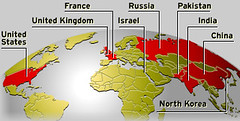
Beyond global diplomacy and potential implications, which appear obvious to us, North Korea has challenged the world in the ultimate high stakes game of communication. From the North Korean government's perspective, it has obviously decided to wager its survival as a closed, tyrannical state against its desire to become an independent and autonamous world player, answerable to no one, much like it perceives China, Russia, and the United States as answerable to no one. Its communication in the last 24 hours was unmistakably premeditated, deviously calculated, and a grave mistake that will have consequences well beyond its borders.

Announcing the test, void of any details, was strategically designed to keep the world guessing whether North Korea is scientifically capable of producing weapon-grade nuclear armaments while stating, unequivocally, that it would no longer answer to anyone, not even the Chinese, who have until recently remained sympathetic to North Korea's direction as a communist country.

President's Bush's response was equally and purposefully vague with ample foreshadow. He said “This was confirmed this morning in conversations I had with leaders of China and South Korea, Russia and Japan. We reaffirmed our commitment to a nuclear-free Korean Peninsula. And all of us agreed that the proclaimed actions taken by North Korea are unacceptable and deserve an immediate response by the United Nations Security Council."

Message: We are not alone in this, which explains why US Ambassador John Bolton presented 13 elements of a punitive resolution condemning N. Korea’s nuclear weapons test to the UN Security Council. The resolution includes inspections of all inbound and outbound cargo from North Korea.

"The North Korean regime remains one of the world's leading proliferators of missile technology, including transfers to Iran and Syria."

Message: We know Syria and Iran seem to be moving closer to what they perceive as a justified a preemptive strike against Israel. Any aid in such a strike, in particular nuclear weapons, could potentially move them to the front of the list.

"The transfer of nuclear weapons or material by North Korea to states or non-state entities would be considered a grave threat to the United States, and we would hold North Korea fully accountable for the consequences of such action. The United States remains committed to diplomacy. And we will continue to protect ourselves and our interests."

Message: We prefer to delay action at the moment, but if you continue to cross every line we have drawn, which further aggravates more pressing interests, we will aggressively pursue de-nuclearization of North Korea by any means necessary.

In the days and weeks and months ahead, it will often be the communication of the message, and not always the action, that will ultimately determine the outcome not just in North Korea, but also the rest of the world. If any US action appears weak, it will only encourage countries like Iran and Syria to step up their own nuclear proliferation programs as such rougue states continue to establish loose alliances out of paranoia, desperation, or perceived opportunity.

Why else would a South American leader choose now to suddenly have a strong opinion of Bush, if not to suggest he sees the potential for or even actively seeks common ground with the Middle East?

Friday, September 29

E-mailing Is Never Private

The first e-mail rule I tell every client or public relations professional is: don't send it unless you would be proud to see it on CNN.

Unfortunately for Rep. Mark Foley, he was never a client or a student. CNN reports he resigned today after a former congressional page questioned e-mails Foley had sent to him.

Foley apparently sent the e-mails in August 2005, when the male page was 16 years old.

"Today I have delivered a letter to the speaker of the House informing him of my decision to resign from the U.S. House of Representatives, effective today. I thank the people of Florida's 16th Congressional District for giving me the opportunity to serve them for the last twelve years; it has been an honor," said Foley. "I am deeply sorry and I apologize for letting down my family and the people of Florida I have had the privilege to represent."

In the e-mails, which were obtained by Washington-based Citizens for Responsibility and Ethics in Washington (CREW), Foley discussed a second page, saying "I just emailed [him]... hes such a nice guy... acts much older than his age... hes in great shape... i am just finished riding my bike on a 25 mile journey now heading to the gym... whats school like for you this year?"

Foley then asked the page for a picture.

The young man, who forwarded the e-mails to another congressional staffer, called the e-mails "sick, sick, sick."

"Maybe it is just me being paranoid, but seriously. This freaks me out," the page wrote in the e-mails obtained by CREW.

A spokesman for Foley told CNN the congressman acknowledged he had an e-mail exchange with the former page but flatly denied that it was anything inappropriate.

Of course, if there was nothing inappropriate, one has to wonder how he let his family and the people of Florida down.

I'm not going to add any speculation on the implications, but limit this to the aforementioned lesson. There is no such thing as private communication anymore, especially in e-mail or on voice mail (as State Sen. Dina Titus recently learned in Nevada).

Thursday, September 28

Advertising For Heaven

Most people know Orbit gum will not get you into heaven, but it still made the Mouse Print blog list (Mouse Print still praises Wrigley for its tongue in cheek sense of humor). Less flattering is a post that unlocks Scott toilet tissue's claim to give you more sheets per roll (1,000) when they actually cut back the per sheet size (leaving each roll 300 inches shorter).

So what is Mouse Print? Mouse Print turns advertising on its head by focusing on an ad’s asterisked fine print footnote rather than the headline. Some posts point out the harmlessness of advertising's entertainment value. Others point out product flaws (Aquafresh for Kids contains peanut oil but does not disclose it). A few cover borderline bait-and-switch tactics like a bank that promises a 10.38 percent return (but limits the rate to a $500 deposit).

Mouse Print does make it a point to mention that it is not illegal for companies to downsize or draw attention away from less desirable attributes, in many cases. Some ads do indeed explain themselves despite any hype or attention grabbing headlines.

The lesson that advertisers can learn by visiting the blog can be found in the comments on each post. People are generally unhappy with questionable product claims or unjustifiable footnotes (some advertisers have to use them for legal purposes). Statistically, one unhappy consumer will generate at least eight more.

The irony is that, in most cases, the more overzealous claims are largely unnecessary in selling products. Most products have at least one unique selling point (or a few contrast points) to rely on. But then again, knowing that too much hype is not worth creating unhappy consumers is one of several reasons developing a successful ad campaign is simply about being clever. It's challenging in that every clever idea is based upon strategy, something consumers appreciate without hype.

Wednesday, September 27

Increasing PDA Security


GFI, a international developer of network security, content security, and messaging software, recently launched a new white paper about the new and increasing threat of "Pod Slurping."

The paper explores the threat posed by portable storage devices and considers security measures that should be implemented in addition to perimeter solutions such as firewalls and anti-virus software. Easy connectivity and high speed data transfer means that by simply plugging a device into a USB or FireWire port, a data thief can get away with more information than ever before. This increasing leakage, ciphering and disclosure of corporate data have been coined the term "pod slurping."

There is no denying that these devices are increasingly popular -- by 2009 it is expected that shipments of iPods and other MP3 players will surge to nearly 124 million units.

"Data slurping is a very simple and automated process. It doesn't require any special technical expertise to steal a company's data using a portable storage device," said Simon Azzopardi, MD EMEA, GFI. "A company needs to protect its network by introducing technological barriers that enable control over data transfers throughout the network."

To download a copy of the White Paper, visit Pod Slurping White Paper.

Tuesday, September 26

Attacking Allen's Past

Recent headlines have created a buzz about Sen. George Allen after three former college football teammates say he repeatedly used an inflammatory racial epithet and demonstrated racist attitudes toward blacks during the early 1970's.

Perhaps it's because one of my favorite made-for-TV movies in the 70s was Brian's Song, which recalls the details of Brian Piccolo (played by James Caan), a football player stricken with terminal cancer, and his friendship with Chicago Bears teammate Gale Sayers (Billy Dee Williams), who helps him through the difficult struggle, but the so-called Allen controversy is none too surprising to me. Allen, like many people, grew up in an era known for racial tension and played in a sport that struggled with the question of desegregation. Many people were confused about race at the time, black and white equally.

For those of you unfamiliar with the film, racial tension is created after team coach George Halas decides that the pair should room together during training camp and road games because they are both rookie fullbacks. Given the fact that Piccolo is white and Sayers is African-American during a time when blacks were still fighting for civil rights in America, it was viewed as a progressive and controversial decision. At the time, no black player had ever been the roommate of a white player in the history of the NFL. Eventually, the racial tension gives way to understanding.

It seems that Allen took a somewhat similar journey in that he once embraced some shortcomings of 70s-era Southern culture, but then later concluded the Confederate flag was a symbol of violence for black Americans (as opposed to thinking it a symbol for the Dukes of Hazzard) and expressed some regret. "There are a lot of things that I wish I had learned earlier in life," Allen said in an appearance this month on NBC's "Meet the Press."

"I grew up in a football family, as you well know, and my parents and those teams taught me a lot," Allen said on the program. "And one of the things that you learn in football is that you don't care about someone's race or ethnicity or religion."

At present, this does not seem all that dissimilar from the made-up brand damage recently experienced by Tiger Woods' wife, where false allegations created some temporary brand damage. In truth, of 19 former teammates and college friends, two said they do not remember Allen acting in an overtly racist manner. Seven others said they did not know Allen well outside the football team, but do not remember him demonstrating any racist feelings. Seven more teammates and friends said they knew Allen well and did not believe he held racist views.

The seemingly lone, non-anonymous vocal attacker is a radiologist in North Carolina who played tight end on the team when Allen was quarterback. He claims Allen came to Virginia because he wanted to play football in a place where 'blacks knew their place' and used the N-word on a regular basis. Ironically, it was the radiologist who sported the nickname 'wizard.'

I'm unconvinced that Allen was an active racist as this former teammate claims, but Allen's team has to do a better job addressing it in a timely manner. Unresponsiveness gives credibility to even the most baseless charges.

Friday, September 22

Suing Over Myspace

Last year, I wrote a post about the growing popularity of blogs and the pressure being created to define a 'legitimate' journalist in (Blogging To Journalism), citing that neither the First nor Fourteenth amendment defines the press or 'journalists' as people who are affiliated with big media conglomerates or whose work is distributed on paper. In short, bloggers deserve the same protections afforded to journalists.

However, in the same post, I also suggested the real question people should be asking is not whether bloggers should be protected by the First and Fourteenth amendments, but whether they should be held to the same standards as mainstream journalists in regard to accuracy and libel. Maybe it's time they were, I said, especially those that unjustly libel individuals and coworkers whenever they like.

Sixteen months later, that question is being asked as a high school assistant principal sues two students and their parents, alleging the teens set up a Web page on MySpace.com in her name and posted obscene comments and pictures.

Anna Draker, an assistant principal at Clark High School, is claiming defamation, libel, negligence and negligent supervision over the page on the popular free-access Web site. She claims two 16-year-olds, a junior and a sophomore, created the page using her name and picture and wrote it as through Draker herself had posted the information, according to Draker's attorney, Murphy Klasing.

The site falsely identified Draker as a lesbian. Klasing said Draker, who is married and has small children, was "devastated." MySpace.com removed the page when Draker told them it wasn't hers. Bexar County Assistant District Attorney Jill Mata would not release information about the case, but confirmed that juvenile charges are pending against a local high school student involving retaliation and fraudulent use of identifying information. Both are third-degree felonies.

As I said before, with freedom comes responsibility. Unfortunately, no one seems to have told these teenagers that once you publish a blog, you become a publisher, bound by the same libel laws as the rest of us. Be bold, but be honest.
 

Blog Archive

by Richard R Becker Copyright and Trademark, Copywrite, Ink. © 2021; Theme designed by Bie Blogger Template