Wednesday, November 26

Thanksgiving Is A Good Day To Be Grateful To Be Alive.

"I did a bad thing and have to confess," read the text. "I snuck one cookie. I just had to have one."

"It's all right," I wrote back. "I made a double batch."

"So how is it possible that they're better and better every time you make them?"

It would take too long to answer that question in a text so I joked about not giving up any secrets. In reality, there are no secrets. My recipe has remained unchanged. It's everything else that is different.

I might mix up my Thanksgiving dessert list a little every year, but chocolate chip cookies have become a first string favorite. The same goes for other holidays and gatherings too. People like them.

As a first string favorite, I make them often enough that I've stopped tinkering with the recipe and started tinkering with everything around the recipe — the consistency of the batter before adding flour, the right size of the cookie ball before it is baked, the best temperature of my particular oven and the right rack to put the pan on, and a dozen other details that would bore most people. All of it matters if you want to make a great cookie. And the only way to do it is to practice making it perfect.

This isn't all that different from what I tell my daughter's softball team as one of the coaches. Practice doesn't make perfect. Perfect practice makes perfect. So every time they step up to the plate or set their feet to throw a ball, they strive for perfection  — at warmups, practices, and ball games.

You can't expect to throw someone out at first or pick up a base hit if you slack in practice or goof around during warmups. In fact, it's improper practices that create bad habits and cause poor game performances. And this is so true, it seems, that no practice is better than a bad practice for many players.

The same thing goes for baking cookies too. If you're not willing to strive for a perfect practice, then there isn't any reason to expect better cookies. It's those simple things that make all the difference.

We tend to overlook simple things. But it's the simple things that make for perfect practice. 

In softball, the difference between a hard hit and soft hit can be attributed to something as simple as turning the back foot. With chocolate chip cookies, the difference between good cookies and great ones can be something as subtle as how cold the dough is before you put it in the oven. As a writer, the difference between informing or inspiring is often tied to sentence structure or even word choice.

It applies to anything and everything else too. You can't expect an organized pantry if you fill spaces as opposed to putting things away in their proper places. You can't expect to feel great more days than not if you aren't willing to make physical fitness one of your priorities in life. And you can never truly appreciate anything in life until you learn to be grateful for being alive.

At least that was my takeaway when my family and I celebrated my birthday last week. A friend of mine asked what my big plans might be for my birthday and I told him that I was cleaning out a closet and then cooking dinner — filets, bacon wrapped shrimp, double stuffed potatoes, and peas. He laughed and said that all sounded like a lot of work. Maybe everyone ought to do that for me, he said.

I laughed and joked that I would have to waste a wish when I blew out my candles to make that happen. But no, I don't think so. Birthdays aren't be about being spoiled. That's just icing on the cake.

Sure, five years ago or so I used to think that birthdays were about people spoiling me. Nowadays, I think about birthdays as a day to be grateful to even have a life. And for me, I couldn't think of a better way to celebrate having a life than by making a non-functional closet functional again and cooking an indulgent dinner to share with my family. I consider it a perfect practice for a better life.

Sure, there was a cake to enjoy after dinner. Yes, there were some gifts I really appreciated. But the real lesson learned can boiled down into appreciating that everything about a birthday is pretty amazing if you're grateful to even have one. The rest of it is a bonus, kind of like homemade cookies.

So if you really want to know why my cookies are better every time I make them, the reason is pretty simple. I've stopped chasing outcomes and started working toward perfecting practices. And that, more than anything else, has made me more grateful than ever — for my friends, for my family, for the few people who read this post, and for my very life.

Thank you for that and happy Thanksgiving. Good night and good luck.

Wednesday, November 19

Word Of Mouth Doesn't Distinguish Between Online And Off

The decade-long era of marketers attempting to distinguish between online and offline word of mouth is over. As consumers have adopted small screen mobile technology and social networking tools, few people make the distinction. Most don't even remember when or where the conversation occurred.

All they remember is that the recommendation came from a friend or family member. The details of its delivery (text or network, phone call or in person) is largely lost to them. All they remember is someone close to them (not an "influencer" based on popularity but an "influencer" based on proximity) had something to say about a particular product, service or solution.

Word of mouth directly accounts for about $6 trillion in consumer spending, online and off.

And it is these conversations, which are personal and person to person, that account for as much as 13 percent of all consumer sales and as much as 20 percent among higher price-point categories. And the division between online and offline conversations just isn't there. It's no longer relevant.

This finding and others were recently published in a study organized by the Word of Mouth Marketing Association (WOMMA) in partnership with AT&T, Discovery Communications, Intuit, PepsiCo, and Weight Watchers. The study is based on the econometric modeling of sales and marketing data provided by participating brands (on a confidential basis) and conducted by Analytic Partners.

The results of the study may change the way some marketers think about paid and earned exposure, with about one-third of sales attributable to word-of-mouth conversations acting as an "amplifier" to paid media such as television. In sum, consumers spread advertised messages one-third of the time.

The rest of the impact is independent of advertising and tied to other influencers such as product or customer service experiences, public relations, owned and earned digital content, referral marketing, and related activities. These influencers work in tandem to shape overarching brand perceptions.

Other key findings from the study underpin the power of word-of-mouth marketing.

• Word-of-mouth impressions drive at least 5 times more sales than a paid advertising impression.

• Word-of-mouth impressions for higher price-point items are as much as 100 times more impactful.

• Word of mouth impacts tend to influence consumers closer to the time of purchase over media.

• Word of mouth amplifies the effect of paid media by as much as 15 percent.

"Intuitively, we know that a consumer recommendation is going to be a powerful contributor to brand sales, but this is the first time a rigorous study has quantified that impact across a range of product and service categories," said Suzanne Fanning, president of WOMMA. "We hope this research will lead marketers to elevate the role of word of mouth, both online and offline, in their marketing plans."

This study also reinforces the idea that marketers who are more inclined to communicate a clear contrast between their products and services will be more likely to have a message that consumers are not only able to remember, but can also readily share with friends and family members. And considering that the average consumer can only recall one to three messages about any paticular product or service (not all of which are written by marketers), it had better be something clear and compelling.

Wednesday, November 12

Did Millennials Change Advertising Or Just Roll It Back?

By some estimates, millennials now include about 74.3 million people in the U.S., which accounts for almost 25 percent of the population. They have between $125 and $200 million in purchasing power.

Advertisers are just now beginning to understand that millennials prefer friendly and funny brands over serious and stodgy. Two in three like smart and witty humor and about 72 percent consider being smart as one of their greatest assets. They still self-identify with some brands, but in slightly different ways. 


And if there is any irony to be found in that lineup of four advertising tips for millennials, it's that nothing has changed. Targeting the same age demos in the 1960s and 1970s called for the same four tips.

The shift everyone is talking about in advertising is circular. 

Advertisers of that era made them laugh, made it personal, made it social, and engaged them. And it wasn't until the 1980s that things began to change and brands suddenly became bigger than buyers with product glamour shots outweighing golden era advertisements at about 4 to 1.

The trend continued well into the 1990s and 2000s as advertisements became bigger, freakier, and more increasingly Photoshopped or loaded with special effects that were meant to wow every audience. Most of them got plenty of attention, which is what advertisers want to do, but it came at a cost. 

Some might even say they broke from the old Ogilvy tenet that advertisements ought not attract more attention than a product. He also commissioned research that found images can turn off interest.

The truth is that while most clients want great campaigns that ignite sales and the have the staying power to build a brand, most consumers want honest advertisements that tell them exactly why they might care to even consider the purchase. And if you can make them laugh a little too, even better.

The lesson advertisers must continue to learn here is pretty simple. Much like public relations professionals need to transform "us" and "them" into "we," advertisers need to push beyond attention-grabbing entertainment and create opportunities for millennials and others to participate and be part of whatever the marketer is hoping to achieve. Ergo, it's not about you or your product as much as them. But then again, maybe it never really was about you or your product. Don't be the star. Make some.

Wednesday, November 5

Yes Virgina, There Are Impassioned Objectivists

Anytime I mention "objective journalism," someone contests the concept. They consider it an idealistic pipe dream. They claim that all journalists are biased. And they say it lacks the passion of advocacy journalism. But more than all that, they say objective journalism is dead. Get over it.

Sure, there is some truth to the statement that objective journalism is dead, but we mustn't mistake its current condition as evidence that the idea is boorish, flawed, or impossible. As defined, objective is an individual or individual judgment that is not influenced by personal feelings or opinions in considering and representing facts. And it's a quality that communicators ought not run from.

Objectivity comes with honesty and maturity. Grow up already.

The real problem it seems is that objective journalism allowed itself to be saddled with ideas that have nothing to do with objectivity — traits like fairness, indifference, and perfectness. Specifically, people expect that journalists (especially those who strive to be objective) must listen to both sides, transcend human frailty in hearing them, and then deadpan the facts for the public. But that's not it.

A working definition of objective journalism is more akin to how Iowa State journalism professor Michael Bugeja defined it: “Objectivity is seeing the world as it is, not how you wish it were.” The idea is that the communicator is willing to commit to the pursuit of truth, not what they hope is true.

People strive to be objective every day. A manager might like one employee better than another but promote the one with stronger skill sets. A coach might play the more talented player over their own child for the good of the team. A scientist might prove his theory wrong after reviewing empirical evidence. A judge might make a ruling that is right but weighs heavily on his or her heart.

So why would journalists somehow be incapable of striving to be objective (unless they don't want to be) where others have demonstrated the ability to succeed? It seems to me that all it would take is someone becoming impassioned to find the truth rather than promoting their own agenda or whatever agenda they have subscribed to believe. And it's in this passion for truth, rather than propping up fragile brands or frail ideologies, that deserves our respected admiration.

Forget balanced. A journalist might glean insight from different perspectives but truth doesn't take sides. Forget deadpan deliveries. Objectivity doesn't require anyone to feign disinterest in the face of outrage. Forget unconscious bias. The goal was never to transcend being human but merely to develop a consistent method of testing information, considering the evidence, and being self-aware of any personal and cultural bias. And all of these ideas were born out of a need for objectivity.

As as much as I have a fondness for Hunter S. Thompson, who had plenty to say about the objective journalism of his day, the lack of it enslaves us as the only "truth" that prevails is the one uttered with more frequency, more volume, and a more passionate will. And eventually, when the truth is no longer valued in favor of that "truth," it seems to me that we will finally find affirmation media to be an insult to our intellect and own sense of evidence.

Objective communication isn't limited to journalism. Stop saying yes. 

The Pew Research Journalism Project identified nine core principles of journalism, but I've always been partial to the idea that objectivity adheres to empirical standards, coherence standards, and rational debate. Empirical standards consider the evidence. Coherence standards consider how it fits within the greater context. Rational debate includes a diversity of views, but only gives merit to those views capable of meeting empirical and coherence standards.

In much the same way objective journalists strive to look out for the public interest, professional communications — marketers and public relations practitioners — better serve organizations (and the public) by applying objectivity to their situational analysis and measurements of outcomes. The stronger communicator is always the one who is objective as opposed to those who only aim to validate their actions or affirm a client/executive/decision maker's perceptions by saying yes.

Can we ever be certain? The answer is mostly no. While we can tear apart a baby's rattle and see what makes noise inside, we cannot see into the hearts of men and women to guess at their intent before there is any evidence of action. The best we can hope for is that those who have no intention of being objective wear the proclamation on their sleeves while others are given the benefit of the doubt until they prove otherwise. Let the truth lead for a while and see what happens.

Wednesday, October 29

The PR Call To 'Be The Media' Is A Misnomer

There's no question that social media has become an important part of the media/public relations landscape. Given that the media have completely integrated social media into journalism, it makes sense. And social, after all, has been integrated into every facet of communication and beyond.

It has become such a big part of public relations that there is even some ground swell over the notion that public relations could eventually "be the media" with equal footing. And why not?

Some firms even say that it's essential if businesses want to "reassume direct control over their reputations and news flow." Others say that it's a surefire solution "to become a producer as opposed to a facilitator" and earn a larger piece of the MarComm budget. And yet others think that in doing so, they can "skip the media middle man all together." It might even be vital to do so in some cases.

Being the media is not an evolutionary step for public relations. 

You don't have to subscribe to the notion of content shock to see a real problem with companies attempting to circumvent the media. The real problem is that it moves public relations away from its core tenet to strengthen the relationships between the organization and various publics in favor of a top-down communication — the same one that social was once purported to solve once and for all.

It also changes the perspectives, objectives, and outcomes of the communication. As quasi media, companies are incentivized to measure the reach, engagement, and conversion outcomes over programs designed to ensure mutually beneficial and measurable outcomes for the organization and its publics. And while it's true both efforts can work in tandem, the thinking is light years apart.

Reputable public relations teams would never view the media as a 'middle man' but rather as one of its very important publics — a reasonably objective (hopefully) voice that assists in bringing clarity to important issues, even those that are relatively niche. They also also understand that the increasingly diminished role of the media leaves an organization front and center as a direct source that must compete for attention against anyone who is looking for link clicks.

In other words, skipping the so-called media middle man further fragments communication, with each organization vying for its share of spotlight. It also opens up cause for corporations to supplant independent news, justified by the mistaken belief that the concept of objective journalism is a myth.

It seems nowadays that many public relations professsionals (and journalists) fail to understand that objective journalism works because the method is objective, not necessarily the journalist. And when objective journalism is allowed to work, it serves organizations and the public by vetting any claims, setting the agenda, and supporting the truth when the facts are paramount to the public good.

The evolutionary next step of public relations is collaboration.

Don't misunderstand the message here. Content marketing, social media, and corporate journalism have become vital components for any communication plan. But all of these tactics work best when they are employed in tandem with media relations, public relations, and other collaborations — something that even marketers see as having tangible value across multiple media venues.

Sure, I've always been an advocate for integrated communication, direct-to-public public relations, and teaching public relations professionals to think like a journalist. And at the same time, when it comes to public relations specifically, I also remind students that the simplest definition of the field is to transform "us and them" into "we," which would include a shrinking pool of pure journalists.

Wednesday, October 22

What If The Only Hurdle Is What You Think?

A few nights ago at her practice, my daughter (age 8) and her softball team (8U, ages 8 and under) were challenged to a base-running relay race by their sister team (10U, ages 10 and under) in an older division. They readily accepted despite the odds.

Two years makes a big difference. Most of the girls on the 10U team had a 12- to 18-inch height advantage and the stride to go along with it. Even with a few 'accidental obstructions' by coaches to even out mismatched segments of the rely, it was pretty clear which girls would come out on top as victors.

Or maybe not. The race was relatively close in the end, with the team effort being only part of the story. While several 8U girls held their own, one of them gained ground during her segment without any coaching assistance or any easing off by the older girls. She was determined to win her heat.

And then she won it. The size difference didn't matter. The age difference didn't matter. The difference in life circumstances — having been born three months early and enduring juvenile rheumatoid arthritis for going on 6 years — didn't matter either. She won her heat from the inside out.

About 10,000 people a month Google the phrase "am I ugly."

Meaghan Ramsey of the Dove Self-Esteem Project wasn't the first to bring this disturbing trend to light, but she has been one of several voices who has helped raised awareness about self-esteem. Specifically, Ramsey has found a correlation between low body/image confidence and lower grade point averages/at-risk behaviors (drugs, alcohol, sex) and these correlations are heightened through the baked-in pressure of social networks to earn friends, likes and opinions via frequent feedback.


Ramsey contends that our increasingly obsessed culture is training our kids to spend more time and mental effort on their appearance at the expense of other values that make up one's self-concept. It's a good point, especially when you consider the depth and damage of crowd-sourced confidence beyond physical appearances.

Just as low body confidence is undermining academic achievement among students, low social confidence is undermining people well into adulthood. It's increasingly problematic because our society is adding layers of subjective superficial qualifiers that are determined by crowd-sourced opinions and visible connections. Specifically, superficial counts like "followers, likes, retweets, and shares" that have nothing to do with our value as human beings are being used as a means to validate their perception of others as well as their own concept of self.

The key to more meaningful outcomes transcends image. 

The overemphasis of imagepopularity and crowdsourcing in social media has a long history of undermining good ideas, worthwhile efforts, and individual actions. And the reason it undermines our potential as human beings is related to how we inexplicably convince ourselves that we are not pretty enough or smart enough or popular enough to be valued or liked or loved.

If appearances and opinions held true, then my daughter would be the least likely girl on the 8U team to become the fastest runner. But fortunately, no one ever told her that superficial appearances or history should somehow hold her back. So when I think about her, I always want her to be able to apply this same limitless attitude to her potential aptitude whether it is academics, athletics, or attractiveness (to the one and only partner who will ever really matter).

Wouldn't you if it were your daughter, sister, girlfriend, wife, or mother? Wouldn't you if it were your son, brother, boyfriend, husband, or father? Then maybe it's time we all took the effort to let potential not perception prove our realities, online or off. Good night and good luck.

Wednesday, October 15

Are Conscientious Consumers Catered To Or Created?

Consumers
According to Havas PR North America, the rise of the conscientious consumer isn't around the corner. It's happening right now. More people favor responsible brands all over the world.

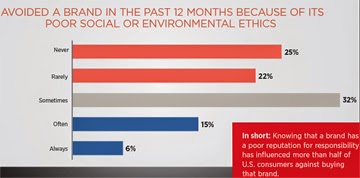
Globally, 34 percent of consumers say that they always or often purchase one brand over another for reasons of conscience. Sixty-seven percent said they would like to do so in the future.

The United States lags slightly behind with 23 percent of American consumers saying they always or often buy one brand over another because it's more responsible. Fifty-four percent said they would like to be more conscientious and buy from brands that support well-being and sustainability.

"In part, this phenomenon is about people everywhere questioning the assumptions of the financial crisis that started in 2007," said Marian Salzman, CEO of Havas PR North America. "And in part it's about using 21st-century tools to get more information in order to be consumers who are proactive about ethical, responsible, sustainable brands. Plus, the transparency trend and many others are converging to bring us to a heightened mindfulness in both consumption habits and social and environmental impact."

This thinking is based upon BeCause It Matters, a white paper that analyzes the thoughts and habits of 23,510 consumers from 14 countries related to issues of conscience. According to Havas PR, the trend in being more conscientious is growing, especially among women and in efforts that require little or no additional effort from them. In short, they want companies to do the real work.

The concepts behind the conscientious consumer. 

The idea of a more conscientious consumer isn't new. It's largely based on the evolution of ethical consumerism whereby people favor ethical products through "positive buying" and avoid companies that don't meet minimum standards through "negative buying" or a moral boycott. The term was first popularized by Ethical Consumer, a magazine published in the United Kingdom in 1989.

Since then, the concept has resurfaced with several other monikers. Several years ago, for example, The Futures Company published a white paper that predicted a dramatic shift in consumer conscience and confidence that would take hold around 2010.

Brand SampleIt anticipated that more consumers would be responsible, vigilant, resourceful, prioritized, and network oriented. And then, a few months later, Euro RSCG Worldwide highlighted the characteristics of an emerging group of prosumers — people who value experiences over ownership, the natural world over the fabricated world, and good corporate citizens over disconnected product promoters.

Euro RSCG Worldwide and Havas PR, incidentally, are one in the same. But regardless of names and monikers, the principles are the same. There are halos associated with topics such as workers' rights, going green, global sustainability, animal welfare, and altruistic efforts. Most of us like the idea that people are somehow, slowly, becoming more conscientious than before.

Of course, that is not to say that the concept doesn't have critics. George Monbiot once wrote that progressive insertion has a tendency to transform itself into self-interest or expectant disinterest by nurturing the mindset that "we've done enough" simply by voting with dollars. Some critical studies support his hypothesis, but most suggest implementation is problematic much earlier. Specifically, the socially conscious consumer might exist but is considerably more elusive or taking the slow road.

What companies really need to know. 

There is a hard core group of conscientious consumer that exists, but it is relatively small despite a
25-year incubation period. In the United States, for example, about 6 percent of those surveyed in BeCause It Matters could be considered hard core. Beyond this 6 percent, 15 percent said they often avoid brands with poor ethics and another 32 percent avoided them sometimes.

Where the emerging conscientious consumer does better is in recommending responsible brands. More than 40 percent of American consumers actively recommend responsible brands (13 percent strongly and 28 percent somewhat). At the other end of the spectrum, about 15 percent said it would make no difference in whether or not they would recommend a brand.

What companies always need to keep in mind is that the emerging conscientious consumer tends to look more ahead than take action. Specifically, in benchmarking studies over the last two decades, what consumers say they will do versus what they actually do is different. We all want to be the  conscientious consumer, but have a much harder time putting it into practice when making choices based on price, product quality, or brand loyalty.

In knowing this, companies wanting to shift toward a conscientious framework must approach the market differently. They need to bake social responsibility into the brand (rather than dilute any potential impact with green washing or marketing-centric donation promotions). They have to produce superior products (because socially conscious sentiment is not enough for most consumers to justify higher prices). And most importantly, they need to realize that conscientious companies don't really cater to the conscientious consumer as much as they are actively working to make them.

Is it worth it? It depends. To succeed, the company needs to establish clear values and a culture that supports them. Marketing efforts need to bake the conscientious contrast point into the brand rather than a campaign. The economic climate needs to be stable enough to support socio-economic mobility, which drives consumer confidence by focusing consumer attention on the future and thereby moving the mindset away from more the immediate cost savings. At least that is what seems to be. What do you think?

Wednesday, October 8

Content Agility Is The Next Step In Content Strategy

Content Agility
Some marketers have earmarked content agility at five years out. It will happen much faster than that in a multi-channel, multimedia world. It's happening now to offset the content creation explosion.

Specifically, content agility addresses the increasing need for horizontal and vertical structures that can organize content not only by search (placing the burden on the consumer), but also by logical pathways (publishers providing opportunities for expansive content). The general idea of content agility is to save consumers time (not demand more of it) by providing clear pathways to their goals.

What does content agility really look like in the future? 

One early example of content agility was featured in a commercial for the Google Nexus 7. Although the commercial focuses primarily on consumer-generated searches (given that it is a Google commercial), content agility takes the concept further by providing consumers touch points that provide opportunities to follow nonlinear pathways toward specific topics and deeper research.


Specific to this commercial, content agility would not wait for the consumer to define a search term, it would be designed to open pathways in nonlinear directions (e.g., to learn more about a president or to learn more about speeches or to learn more about self-confidence, etc.) simply by touching the president or his speech or his hand gesture. Such an interface would feel impossibly intuitive.

What can content agility really look like today?

Right now, most content marketers create content and flood every social channel where they have an outpost with the new content, screaming "hey look, new content." They load it up with hooks and baits too because the entire objective (as stupid as this sounds) is to make us feel an emotional tug to click on a link and learn more (only to be disappointed about 98 percent of the time).

Content agility doesn't operate in this manner. It creates a content hub with increasingly deeper content that is also interlinked with all other content assets when appropriate. For lack of an inactive example, think of Wikipedia cross linking but with a greater emphasis on visual presentation (over text), inactive media, and scroll over interfaces.

Social network marketing can be handled in much the same way. As mentioned, most marketers burp out the same content leads across all channels. But what if they didn't? What if each social network featured very specific content, giving participants different reasons to each network rather than seeing the same content on all of them? It makes more sense and creates much more dynamic engagement.

A few recent articles that are exploring content agility. 

5 Tips To Liven Up Long Stories by Geoff Livingston


Wednesday, October 1

Is The NFL The World's Most Dangerous Brand?

While most of the conversation has revolved around Baltimore Ravens running back Ray Rice after knocking his fiancee (now wife) unconscious in a casino, some people have taken to actively banning the $9.5 billion industry in general. Their decision includes a litany of reasons, ranging from the uproar over the team name Washington Redskins to the high risk of concussions and brain trauma.

There is more, and the list seems to grow longer by the day. Football, which Malcolm Gladwell once likened to the popularization of dog fighting in the 19th century, is clearly in the crosshairs with the NFL seen by some as public enemy number one. Everything done is being questioned. And more than some wonder if it can survive despite record-setting viewership.

How many black eyes can the NFL take and survive?

There is some truth to the notion that troubles inside the NFL are not a public relations nightmare, no matter how many people seem to think so. So let's be clear.  Domestic abuse is not a public relations problem. Child abuse is not a public relations problem. And while all sports carry risk, unnecessary risk is not a public relations problem. These issues aren't black eyes. They're actual punches.

If anything, the problem isn't public relations but this notion that a public relations problem can be weighed, balanced, and counterbalanced by public perception. The real problem is a mitigation issue, which requires a much more proactive focus on long-term measures that reduce or eliminate risk.

Sure, some might argue that everyone has a different threshold in regard to these issues, especially those associated with individual players and their private lives. But highly visible brands can rarely afford the luxury of ignorance. They have to draw a line. For the NFL, the line could be its organizational values as well as a clear code of conduct for players on or off the field.

How a disaster planning model could bolster the NFL brand.

1. Mitigation. Mitigation focuses on long-term measures to reduce or eliminate risk. In this case, it would include a review of the organizational values, policies, and code of conduct that the organization, teams, and players agree to adhere to.

2. Preparedness. Planning, organizing, training, evaluating, and improving activities will ensure the proper coordination of action any time there is a violation of policies. All too often, people see the NFL as being inconsistent in its actions when it would outline something consistent such as treatment as warranted, suspension during investigation, or/and termination on conviction.

3. Response. While response means something different in a natural disaster, the NFL could still benefit from an organized response. The NFL already has a method for issuing certain rulings, but it seems to lack the structure (leadership) and agility (creativeness) to adapt. A clear response to individual, team, or organizational issues would be welcomed.

4. Recovery. Just as recovery aims to restore the affected areas to their previous state before an issue, the NFL could certainly be more proactive in the issues that have been thrust upon it. It is almost unconscionable that no one has thought to allow individual players speak out against domestic violence and child abuse given that the majority of players can live up to their role model images.

Where strategic communicators and public relations practitioners can make a difference is facilitating the communication necessary to help make organizational changes and in providing insight into how other publics (and the public) are reacting or responding to the issue. They can then clearly communicate any organizational decisions and/or work with various publics to reach a consensus.

Naturally, not everyone will agree with whatever decisions are made. But history has shown, more often than not, that people are more accepting of organizational decisions (even those they don't agree with) that are thoughtfully considered, relatively consistent, and within the scope of established values. In fact, this is why so many other sports don't fall under the same scrutiny. They didn't build their brands on representing American values like football has tried to do for the past several decades.

Wednesday, September 24

The Elephant In The Room Of Banned Books Is Gray

banned books
The most common commercialized celebration of Banned Books Week is to create a display of the top ten banned book titles or top ten banned book classics (for sale), thereby making this week sometimes feel more promotional than purposeful. And while this celebration can prove useful in raising awareness or discussing ignorance, it's easy to forget these top ten lists come from a pool of more than 300 titles targeted for much bigger, broader and diverse reasons than we like to think.

This is one of the reasons I appreciated the article penned by Donald Parker that addressed some of the myths and realities of censorship. He cut to the heart of a bigger matter, reminding readers that not all banned books are challenged by conservatives, nor are they confined to school libraries and classrooms, nor are they classified as young adult fiction in an increasingly less tolerant world.

The truth is that censorship is a national problem without any real geographical, demographical, or socio-polictial preferences. People who seek to ban books are young and old, rich and poor, left and right, and live from one coast to the other. When you take a closer look at them, it's exactly as Ray Bradbury once called it in Fahrenheit 451 — whereby "minorities, each ripping a page or paragraph from a book, until one say the books were empty and the minds were shut and the libraries closed."

Eight Articles That Cut Past The Top Ten Lists And Aim At The Elephant.

1. Too Graphic? 2014 Banned Books Week Celebrates Challenged Comics by Lynn Neary. Neary catches up with Jeff Smith, author and illustrator of the popular series Bone, who was shocked to find out his series was named one of the top ten most frequently challenged books in America. Censors typically cite violence, racism, and a political viewpoint.

2. Costco Denies Political Motive For Pulling D'Souza's Book by Jerome R. Corsi. Corsi recaps the recent attempt by Costco to pull a book critical about Barack Obama from its stores. The big box store claimed the decision was made because of poor sales despite showing up on the New York Times bestseller list. Costco is a supporter of Obama and the Priorities USA super PAC.

3. Riverside: "Fault In Our Stars" Banned From Middle Schools by Suzanne Hurt. Hurt covers the best intentions of parent Karen Krueger to remove the book or only make it available for checkout with parental consent in a middle school library because it includes references to two teens having sex. When several members of the school committee agreed that the teen love story was inappropriate for that age group, it pulled the book and would not allow other schools to purchase it.

4. Confronting My Temptation To Ban Books by Paul Brandeis Raushenbush. Raushenbush raises an interesting point in asking people to skip past the top ten mot banned books in America, which he says pose no discernible threat, and challenge any anti-ban convictions by stocking library shelves with "recruitment propaganda from ISIS, or books and essays that perpetuate systemic racism, or sexist literature that denigrates women..."

5. America's First Banned Book And The Battle For The Soul Of The Country by Jim Miller. Miller takes a fresh look at banned book week not by being current but by looking backward. His article touches on the sensitive content of the New English Canaan by Thomas Morton, published in 1637. The book itself was put in the midst of two colonies clashing over ideas — specifically between Puritans and those "other" untamed colonists.

6. School Accused Of 'Purging' Christian Books by Todd Starnes. Starnes runs down the true account of a public charter school in Temecula, California, that stripped its libraries of any book with a Christian theme or by a Christian author. This included The Hiding Place by Corrie Ten Boom, which is a survivor story about a Christian family that helped Jews escape the Holocaust.

7. How Does Banning A Book Work? by Cristen Conger. Conger takes deep dive into the process of banning a book, including the legal precedence that dates back to the furthest reaches of literary history, which includes the work of Socrates in 399 B.C. Today, despite the U.S. Supreme Court already ruling that a book or periodical must be "pervasively vulgar" to constitute adequate ground for banning, people continue to challenge books for one reason or another.

8. America's Most Surprising Banned Books by Theunis Bates and Lauren Hansen. Bates and Hansen put together a list last year unlike most of the lists you will see this week. They told the story of thirteen titles and why someone sought to ban them. One of the more dubious mentions includes Brown Bear, Brown Bear, What Do You See because someone mistook author Bill Martin Jr. for an obscure Marxist theorist who had the same name.

Why The Elephant Is Gray And Books Will Continued To Challenged. 

It's mostly easy for readers and authors and libraries and booksellers to point at the most commonly challenged books in America last year and laugh at the reasons. But when you look beyond the list and consider the bigger picture, you can pinpoint a portrait of what Americans are wrestling with today. Look even deeper and find bigger questions being asked every time books are challenged.

Should books with religious viewpoints be allowed in schools (and is it a religious viewpoint not to have them)? Do parents have the right of oversight by minimizing the accessibility of some books? Is there an appropriate age limit for certain content (and if so, then who decides)? Are depictions of racism part of the problem or part of the solution?

Does expressing sexuality breed tolerance or temptation? Should booksellers be forced to sell all books or only those they agree with and support? Are history books beginning to exploit the power of complaint and using emotional bribery to invent ever increasing levels of social guilt? And what about those other books — the ones specifically written to incite, recruit, or defame?

These questions aren't always as easy for everyone as people tend to rally to protect their own beliefs and convictions but generally struggle to protect those they consider in opposition to their own. How about you? Is there a line you won't cross in defense against censorship? Maybe there are many lines.

Wednesday, September 17

Does Your Content Marketing Consider Customer Complexity?

As much as marketers are working to understand their customers as data points, many of them still need to understand their customers as real people. That is the fundamental challenge with big data — retaining the ability to see the unique individual within the throng of the crowd that it tends to track.

When you separate out one individual from the crowd, even as a thought exercise, it's easier to ask relevant questions. Who is this person? What do they want or need to know? How will they make their decision? What content would they be most interested in receiving? How will they use it? 

With the exception of this space (which is driven by a different purpose), I ask myself these questions every day. And when the opportunity presents itself, I spend time with the people we want to reach. 

People are infinitely complex and you're fooling yourself to think otherwise. 

If I have learned anything in advertising and marketing over the last 25 years, it's that consumer profiling just isn't good enough. While it can be helpful in capturing a snapshot of behavior and communicating it to other marketers or executives, it tends to dismiss the complexity of people.

Understanding people with any sense of depth requires a culmination of layered analysis that considers a dozen different aspects at once. For the purposes of illustration, pretend there are three.

Personality (Core). When you work with so many diverse marketers, you become familiar with all sorts of profiling tools that are designed to better understand people. One of the most useful was considering the four personality types (or nine if you prefer) that identify common foundations people operate from. 

For content creators, knowing that controllers needs to know the bottom line, analyzers want all the details, promoters are looking one step ahead, and supporters want to know how it benefits everyone else, can have a profound impact on content structure.

Learning (Input). As recently included in a guest post published by long-time friend and marketer Danny Brown, people consume information differently. In education, for example, learning styles include: visual (see), auditory (told), kinesthetic (touch), and language (read/write). 

Marketers who know it are much more likely to consider a multimedia approach to their digital marketing efforts. Multimodal communication tends to resonate better and benefit from longer recall.

Behavior (Output). While not everyone appreciates it today as they did when the content was fresh, Forrester Research did an excellent job in mapping out a Social Technographics model (or what many people have come know as the social media ladder). The ladder largely breaks down participants by the activities they are most likely to engage in online. 

These would include content creators, conversationalists, critics, jointers, spectators, and inactives (or passive consumers). How these different groups stack up in the data is interesting, but what is more interesting (from my perspective) is how these communication pools choose to consume, adapt, share, and build upon the content they are exposed to (if at all). 

Considering such dynamic individualities makes marketing invaluable. 

Creating content is one thing, but creating it (and embedding it within a content of diverse communication) so that it appeals to various personalities who consume information differently and respond to it differently is something else all together. If you want maximum attraction, retention, and action then the real challenge becomes one of content agility (covered in an upcoming post) delivered at the right time. 

Naturally, this isn't exclusive to online marketing and content. Real communication is much more immersive and seeks to reach people at the right time in the right environment. And considering how challenging that can be, it only makes sense to make sure the content sent makes sense for everyone.

How about you? Do you have any layers or filters that you have found useful over the years? If you do, I would love to know. The comments are yours.
 

Blog Archive

by Richard R Becker Copyright and Trademark, Copywrite, Ink. © 2021; Theme designed by Bie Blogger Template