Last year, video accounted for over 82 percent of all web traffic, with TikTok boasting 1.04 billion active users and YouTube setting the high bar at 2.6 billion. Latecomer Facebook Reels is just under 620 million.
Thursday, October 24
Producing Video: A Shift In Content Creation
Last year, video accounted for over 82 percent of all web traffic, with TikTok boasting 1.04 billion active users and YouTube setting the high bar at 2.6 billion. Latecomer Facebook Reels is just under 620 million.
Saturday, July 27
Signing Books: Late Summer Book Tour
Along the way, I'm hoping she learns a few things, too. Some of what I hope she learns comes full circle to that column I wrote ten years ago. The overemphasis on image, popularity, and crowd thinking in social media life has a long history of undermining good ideas, worthwhile efforts, and individual actions.
Ten years ago, I wasn't a novelist. I'm on a book tour this summer.
People tend to ask authors two common questions. First, what advice would you give to any aspiring writers? Second, what was the worst advice you ever received?
I have a variety of answers to the first question in interviews but the one that stands out the most hit me today. Don't wait. We spend far too much time fretting over reasons not to pursue our passions.
The second goes hand in hand with the first. Don't start because you'll never finish it is the worst advice I ever received. And if you finish it, they cotninued, no one will ever read it. It doesn't even matter if we hear this bad advice from someone else or that little voice in the back of our head that prefers practicality over aspiration. Don't believe it. I've sold thousands of books.
I've also lined up a book tour that coincides with the trip. We'll take in some sights and stop at bookstores along the way. You can follow us on TikTok, Instagram, X, Facebook, and elsewhere. Or, even better, drop by if I am in your area (or afterward to snap up a signed copy left behind). Event times will be posted on Facebook as they are finalized.
Pretour Warmup
July 16: The Book Haven in Prescott Valley, Arizona
Summer Book Tour
August 26: Barnes & Noble Grand Junction (signing) in Grand Junction, Colorado
August 27: Old Firehouse Books (visit) in Fort Collins, Colorado
August 28: Barnes & Noble SouthPointe (signing) in Lincoln, Nebraska
August 29: Bumble Books (signing/reading) in Amana, Iowa
August 31: The Atlas Collective (visit) in Moline, Illinois
September 2: Wordsmith Bookshoppe (signing) in Galesburg, Illinois
September 3: Spine Indie Bookstore (author showcase) in St. Louis, Missouri
September 5: Commonplace Books (signing) in Oklahoma City, Oklahoma
September 6: Barnes & Noble Coronado (signing) in Albuquerque, New Mexico
September 7: Page 1 Books (signing) in Albuquerque, New Mexico
Posttour Wrapup
October 19: Las Vegas Book Festival in Las Vegas, Nevada
Stay tuned. I might be adding another mini-book tour in early October. My sights are set on Maine, Massachusetts, New Hampshire, and Rhode Island. The trip is still tentative, but I hope it will help move my next WIP forward. It's set in Maine and will become my second novel, and fourth or fifth book (depending on what happens in the next few months). Pretty exciting — stuff I would have done sooner had I already carved out time to write fiction alongside client work. And that's the point.
I've never been happier writing fiction. In fact, doing so has elevated my commercial work too. And that's what I want my daughter to learn before I drop her off at her new home away from home. Don't wait. Be happy.
Monday, May 6
Pushing AI: A Reduction In Creativity
In his book The Creative Act: A Way of Being, Rick Rubin praises artificial intelligence (AI). But he doesn’t find its strength in being creative as much as in seeing problems with a fresh perspective.
He highlights AlphaGo’s approach to the game Go as his example. AlphaGo, the first AI to defeat a Go grandmaster, applied a never-seen-before move that no human would have made. Indeed. Most humans saw the move as a mistake when the AI made it, failing to recognize anything beyond the two choices that the grandmaster expected the program to make. But the algorithm didn’t care about 4,000 years of Go history. It was programmed to win. It did.
Rubin is right in that the AlphaGo win is a teachable moment for human beings. Sometimes, we carry too much emotional, intellectual, and historical baggage around with us to be truly creative. Ergo, divergent thinking is still king when it comes to creativity.
Divergent thinking is also where the proliferation of AI ceases to interest me. Don’t get me wrong. I still pay attention, especially when my colleagues point it out.
Hugh Behm-Steinberg, who teaches writing at the California College of the Arts, recently did so when he mentioned: “One of the dark pleasures of teaching uncanonical work is reading the AI hallucinations my students think I won’t notice.”
To be clear, Behm-Steinberg allows AI assistance if his students include their prompts with the work. He says it’s better than forcing them to sneak it into their assignments and then failing them when he spots what he calls AI hallucinations (something nonsensical, akin to those crazy hand defects that litter some graphics).
I don’t know. After seeing the first official music video made with OpenAI’s Sora on LinkedIn, I still struggle to condone its broader applications that attempt to supplant human creativity. The video is largely unoriginal, with horrible camera angles and bad morphing effects that cause some people motion sickness — AI hallucinations that we can see rather than read. It’s a fail, propped up only by the crutch of AI infancy.
So, what is the status of AI creativity? There isn’t any. I mean, using AI editors as a prompt to improve sentence structure is one thing, along with applying a photo effect that saves some tedious pixel tweaking or creating elements that can inform a component of a bigger project. Those are suitable solutions. This continued pursuit of trying to make it capture a human’s imagination, on the other hand, is faulty by design.
At its core, the true strength of art in all its forms is one human’s mastery over some medium so they may share their unique perspective of the world with others. These perspectives — a lifetime of experience and knowledge and, sometimes, the purposeful subtraction of said experience and knowledge — is more unique than a human iris. And this is why AI, programmed to mix and match other people’s work, will never truly obtain human creativity — even if it is constructed to be born and live like a human being. Because, even if it were built to be born, then it would still only represent a single point in an infinite ocean of stars.
No. More likely, AI merely represents a reverse renaissance or a great reduction in creativity. As humans allow machines to copy processes, techniques, and rules, they may become even lazier in the pursuit of original thinking. And it will be only then that AI may succeed in simulating something superior, not because it’s creative but only because we will cease to be.
Ho hum. I liked it better when programmers focused on teaching AI to wash the dishes and mop the floors so that we could have more time to be creative. Instead, this trend to program AI to be faux creative will only give us more time to wash the dishes and mop the floors. And we’ll all be too dumbed down to even know the difference. Good night and good luck.
Thursday, February 8
Writing Romance: What’s Love Got To Do With It?
I met my first girlfriend in the third grade. She thought I was a rebel of sorts — a transfer from the public school system, repeating third grade. I wasn’t a rebel. I still couldn’t read.
We were “boyfriend and girlfriend” for three short months. I moved away after the school year ended.
We might have been “together” longer, but she didn’t know I liked her. I always liked her.
I finally worked up the courage to let her know how I felt on Valentine’s Day. I wrote it in the Valentine’s Day card I gave her — the biggest one in the box. They always came like that in a class pack. There were 23 or 29 regular Valentine’s Day cards in the box and one (sometimes two) super special ones. I gave her THAT one.
The only problem was my writing. Because I didn’t read well, I didn’t write well either. So when she opened my card, she wrinkled her nose and joked about how she couldn’t read it. I made a joke about it, too. I didn’t want her to know it came from me. So she didn’t think I liked her because I didn’t give her a card. Or, so she thought.
My second chance came a month later. We had an auction at the school, and she had donated a tapestry with a Native American on it. She thought it was cool because she was Native American, too. But nobody bid on it. So I did. I bid everything I had, which I didn’t have to do. She got the message. I liked her as much as anybody likes somebody in third grade.
Love makes you do crazy things, even when you don’t understand it. It’s one part anticipation and two parts relief. There really is someone out there for you, at least until you move away.
Young love in the novel Third Wheel.
While my novel Third Wheel is often described as a coming-of-age thriller that follows Brady Wilks along the fringe of the 1980s suburban drug scene in Las Vegas, it’s not without heart. In between the tension, Brady pursues two love interests in the book.
The first is with an 18-year-old named Cheryl. The relationship is immediately problematic because Brady lies about his age, fearing she will lose interest, knowing this is the summer before his sophomore year. Brady won’t celebrate his 15th birthday until late fall.
He meets Cheryl early in the book. She is one of several satellites orbiting the parties hosted by his older friend group. Cheryl has every reason to believe he was in her ballpark — a soon-to-be junior or senior — until his adolescent awkwardness gives him away.
For Brady, he is drawn to the impossibility of the relationship and the promise of emotional stability, filling a void that can’t be found in his unstable life. Cheryl puts his troubles on pause, even if he never understands her interest in him.
Because the story is told entirely from Brady’s self-centered point of view, most readers don’t either. Everybody’s best guess is that dating someone younger might even the playing field for a recent high school grad in the 1980s. Sure, while the 70s may have moved the needle on gender equality, the 80s dating scene didn’t know it.
Brady’s perceived rivals drive this point home. They always appear more confident in winning over her attention and affection. With Brady, it’s an internal tug of war. She pulls him toward her and pushes him away at the same time.
She wants it to work but knows it will never work. Maybe Brady feels that way, which is why he leaves himself open for two alcohol- and drug-infused flirtations during the book. One doesn’t amount to anything, but the second one leads to the start of something, even if we never see what exactly that might be.
Brady meets this second girl, Sandy, in a Mob-owned strip club. Despite working as a server and part-time stripper, Sandy is an underage runaway from California, much closer in age to Brady than the lie she tells him.
“Twenty-one, hun.” “Beat you by a year,” he lies in return.
The contrast in these two relationships has more to do with the girls than the boy. When Sandy looks at Brady, she sees a reflection of herself. Despite a facade of self-confidence that initially attracts Brady’s attention, Sandy is just as out of her league as he is out of his.
Broken people tend to attract broken people, and Sandy is empathetic enough to see he’s broken. Together, being broken feels safe and normal. It leads to something much more casual, comfortable, and accidental.
Each relationship is different but somehow gives Brady what he needs most when he needs it. That’s how stories go sometimes.
Love is desperation, anticipation, and infatuation on the front end. It’s affection, acceptance, and attachment on the back end if it lasts long enough. But it rarely lasts long enough because the strongest thing in the world is also the most fragile; hard to find and easy to lose. Cherish every minute before you move away. Happy Valentine’s Day.
Thursday, January 4
Making Connections: Authors And Bookstores
Since I’m tied to my daughter’s softball schedule, I can’t set up book tours like some authors do. Instead, I try to time my introductions with her tournament schedules, emailing or calling a few weeks in advance to set up a book signing or book drop.
The results are mixed. Some independent bookstores can’t be bothered. Others are aggressively disinterested as if someone taking an interest in their store is somehow bad. But then there are a few who are enthusiastically receptive. They know what their customers like and signed copies are easy to sell.
As an introvert, I prefer emailing or messaging bookstores over placing a call but calling is almost always better. I’m still surprised by how many bookstores neglect their Facebook pages and Instagram accounts. (One bookstore even contacted me three weeks after my area visit and arranged to have me ship books instead.) And when a Barnes & Noble employee suggests you email a store manager instead, I’m convinced the address is akin to digital purgatory.
One of my favorite signed book drops occurred in the Bishop Arts District of Dallas, Texas. The store manager, Alan Yanes, was very receptive to having me visit and drop off a few signed books at his store. He was very understanding, too, knowing that we were restrained to the timeframes of the summer softball camp that my daughter was attending in nearby Fort Worth.
Poets Oak Cliff is a small, meticulously curated bookstore owned by writer and poet Marco Cavazos, and managed by a wizard of books and customer service. As fate would have it, Alan is also a Las Vegas native. So, he was especially interested in having an author from Las Vegas visit the store.
Since my visit to Poets Oak Cliff was in the summer, ahead of my release date for Third Wheel, I only had a few trade paperback copies of 50 States with me. Alan took them all. He loved the idea of 50 short stories with one story set in each state. Like many people, he read the story set in his home state first. Later, he read the one linked to Texas.
It was never my intention for 50 States to be read that way, but it’s reflectively common that readers turn to their home states first (or the ones they’ve lived in). Sometimes the story they read first dictates how well they enjoy the rest of it. The harshest criticism I ever received was from a New Mexico native. New Mexico is the shortest story in the book, and he felt I sold his state short. The irony is that there is plenty more to the New Mexico story. I just haven’t finished writing it. (I might finish the next installment for my newsletter in March. We’ll see.)
Shortly after acquiring copies for the store, Alan staged a couple books on the shelf. They were placed in good company, Bukowski’s Ham on Rye to the immediate right. I saved that image to my computer’s browser as a backdrop, replacing the one I took at Bookends in Hawaii.After the visit, my daughter and I toured the Bishop Arts District. The area has more than 60 independent boutiques, restaurants, bars, and coffee shops in the area. It’s a pretty cool place, steeped in history. From what I understand, it was once the site of Dallas’ busiest trolley stops in the 1930s. I can’t wait to visit again. There was more to explore than we had time for because we had to catch a flight home.
Poets Oak Cliff sold out of 50 States in a few days, and Alan ordered more from one of our distributors, IngramSpark. Copies of 50 States are selling briskly, he texted me.
I don’t think he had any idea how much I appreciated it. I told him so but then went a step further by picking up an advanced copy (signed) of Naked Gulls by Marco Cavazos. I loved it, finding it delightfully surprising. It’s a surreal read, breaking from the rules of reality. I reviewed the Hotel California-esque story about a writer who can’t remember checking into a hotel and isn’t allowed to check out, giving it a well-deserved five stars. A couple lines from my review eventually landed in his newsletter.
As it turns out, Marco isn’t the only writer at the bookstore. Although Alan is still working on his manuscript, he had a solid concept in production. I learned a little bit about it when he was in Las Vegas visiting family. We met in a French bakery for a coffee and talked about books, bookstores, and publishing. What else would two bibliophiles do?
We also discussed a return visit to Dallas, specifically for a book signing event, as Poets Cliff Oak was one of the first bookstores to stock my debut novel, Third Wheel. I intend to take them up on it, too. As soon as my daughter’s softball schedule wraps up with a college commitment, my travel plans will be significantly more flexible.
This is what I mean by something special. There is a natural synergy between an author promoting an indie bookstore and a bookstore helping to promote an author they appreciate. Doubly so, in that I’ve also become a fan of the owner’s work because his manager was friendly enough to extend an invitation in the first place, recognizing that authors are also customers.
Whenever you are in the Dallas area, make it a point to visit the Bishop Arts District. Along the outer edge of it is one of my favorite bookstores in the country. Who knows? Maybe we can meet up there in some yet undefined month ahead for a proper book signing.
Monday, September 18
Promoting Literacy: An Accidental Author
Last April, I was a guest speaker at the Kiwanis Club of Las Vegas as an accidental author. Why accidental? I didn't know what else to call becoming an author. I wasn't one of those book dreamers. I couldn't even read.
I grew up in what was then one street over from the wrong side of the tracks in Milwaukee, where my grandparents lived. They raised me. We were poor, and I had a handicap to overcome — having been born with club feet and relegated to casts and corrective shoes until I was 10.
Early confinement has a way of stimulating your imitation. While I played outside more and more as I got older, I fancied myself more as an artist, like the father I lost when I was two. I loved telling stories, but most were acted out or drawn on sweeping rolls of painter's paper my grandfather sometimes brought home from his seasonal job as a trades painter.
I had some talent, but my artistic prowess was problematic. I would fill my spelling book with drawings instead of words — an exercise that landed me in what my school called the "barracks." These were outside portables where other undesirable students (primarily minorities) could be failed forward.
The spelling book stunt wasn't the only reason I was relegated to the lower conveyor belt. Being a deceptively easy mark for bullies didn't help either. You learn to fight or flee early on. Yeah, I fought. What you don't learn to do is read.
"Needs Improvement" as a Badge of Honor
I couldn't read in the third grade. It was one of the reasons I intervened in my daughter's education as early as I did. I didn't want her to land in the same place I did, failing forward until somebody caught you.
In my case, it was my grandmother. She rejected the idea of sending an illiterate kid to the fourth grade. So, she pulled me from public school and re-enrolled me as a repeating third grader in a Catholic school. The school re-evaluated my skills, elevating me in some areas and getting me the help I needed in others.
Say what you will about secular schools. They work well when they work. I don't just mean stricter discipline (although there was that too). I mean, being Christian trumping all other labels. Suddenly, it didn't matter that my skin was a little darker (I'm part Native American), my last name was ethnic (it wasn't Becker at the time), or my feet were in corrective shoes. It felt like a fresh start — for a year, anyway.
Literacy comes from introductions, accidental and otherwise.
With my grandmother dying of cancer, the family decided to reunite me with my mother and her new family. One of the benefits was my step-father figure enjoyed watching movies and ordered HBO through the apartment complex.
I was hooked on fantasy after seeing the animated Hobbit (1977) and Lord of the Rings (1978). For those who remember, the first film only adapted The Fellowship of the Ring and The Two Towers. I had to save up $10 to get the four-book set on my 25-cent-a-week allowance. But it didn't matter. I was reading. I also played Dungeons & Dragons, which encourages reading, writing, and arithmetic.
Fantasy caught my fancy, but I didn't become an avid reader until my family moved to Las Vegas by way of Minnesota. In the seventh grade, my reading teacher let me turn in a book report on the thinnest book I could find. But then he challenged me to read Dune by Frank Herbert. Maybe it was my own move from the land of lakes (Caladan) to the desert (Arrakis), but Paul Atredes was someone I could relate to.
Art was still my first love, except for the fear and the doubt.
My mother didn't want me to become an artist because that was what my biological father did. I gravitated to psychology instead. Writing wasn't even on my radar despite having had a few poems published, a short story serialized in junior high, and a one-act play with subject matter deemed too adult for high school.
While I finished college only two classes shy of a dual major, I shifted toward advertising. I meant to do it with art, but the University of Nevada, Reno (by way of Whittier College) had an advertising track through journalism. They taught me to write — not fiction per se, but everything else: ads and articles.
Most of it was short-form storytelling: Magazine ads, television spots, radio commercials, billboards, news articles, and feature stories. And then more stories, blog posts, websites, campaign strategies, core message systems, and integrated marketing communication. I told other people's stories and then taught other people how to tell other people's stories, too, when I taught classes at UNLV.
It took almost 30 years and thousands of books before I realized I wanted to tell some of my stories. So that's what I did with the release of 50 States. And again with Ten Threads. And again with Third Wheel.
Readers are the people who help others discover reading.
Undoubtedly, my life would be very different had I not learned to read. Sure, I may have become an artist after all. Or not. I could have done a dozen jobs like those I did trying to pay my way through school. I might have been good at them, too, but I was never as satisfied as I am today.
As a reader, I feel like I haven't lived just one life but hundreds and thousands of others. It was an amazing gift that opened my eyes to opportunities. And it's a gift I hope to pay forward.
Sadly, right now in the United States, 48 million people cannot read above a third-grade level, which places our literacy rate at around 79 percent, which is a lower rate than it was in 1875. It peaked in the 1970s and has been declining ever since. Even among those who are literate, approximately half read at about a middle-school level.
In some cases, all they need is a reason to read and the right book to hook them. I recently opened an online bookshop to promote some titles on the eclectic shelf. (I'll be adding two non-fiction shelves very soon; one specifically for writers.) This week, I've also discounted all digital versions of my books: 50 States, Ten Threads (free for Kindle Unlimited members), and Third Wheel in an effort to promote literacy.
Maybe gifting the book or, better yet, promising to read along with someone can make a difference in their lives. That's how my children learned to love books — reading together with me, out loud, alternating paragraphs as we went. It's a technique that works at every age and one I hope you try with someone.
You never know. One day they could become an accidental author too. Or at minimum, part of a national solution. What do I mean by that? Bringing all adults to the equivalent of a sixth-grade reading level would generate an additional $2.2 trillion in annual income for the country, and save between $106–$238 billion in health care costs. We can do better. Good night and good luck.
Saturday, August 5
Reading Early Reviews: Third Wheel
My daughter encouraged me to load the review anyway, a daunting task with only one service bar on my phone. She was amused to see me a little nervous and reassured me it was a good book. I shrugged. She had only read two chapters.
Maybe I should have let it load in the parking lot. Maybe I should have just forgotten about it and enjoyed the view. I might have if it wasn't for the seagull. I already had two early reviews, both positive. And you know the old saying: Two in the pot is better than one caught in a tug of war between the sea and sand.
"Writers aren't supposed to care about reviews, anyway," she mused. She would say that. She's an artist.
Writers don't care about reviews, do we? Yes and no. You get good ones. You get bad ones. It's easy enough to weather reviews nine months down the line as readers express their impressions. It's a little harder to ignore the early editorial reviews ahead of a launch — you kind of need them to give your book lift on the front end.
My first editorial review came from the OnlineBookClub. I had steeled myself through the first paragraph, which is almost always a revised description before the hammer. You hold your breath for paragraph two.
"Third Wheel by Richard R. Becker is an exhilarating story... I rate the book five out of five stars." — OnlineBookClub
I could breathe easy after that, insomuch as anyone can when there are still two or three more due. The second one was from Readers' Favorite. I wasn't sure what to expect because my debut book, 50 States, received a rave review, but only four stars there.
"The best part is the way Becker’s storytelling technique incorporates realistic characters and subplots into a vivid story that is as engaging as it is thought-provoking. Becker deserves plaudits for the effort that went into creating this book and I enjoyed reading it." — Readers' Favorite
With reviews like this, my daughter was probably right. Don't worry about it, not even if the seagull washes right up to our newly purchased beach blanket. So I turned the phone over and then looked again anyway.
"A dark and skillful teenage crime novel with plenty of heart." — Kirkus Reviews
The review went several steps further, praising the prose and my my handling of a challenging protagonist. The verdict was to get it. It's a good book. I took screenshots and sent them to my wife anyway, asking if it was a good review. She smiled at the reviewer referencing John Hughes movies (except darker and more nihilistic) because there's some truth to it. We all lived like that in the 80s. I'll take it.
So my daughter and I decided to celebrate in our own way, dashing across town to catch a mere six innings of a Los Angeles Dodgers game against the Toronto Blue Jays. My book, Third Wheel, fared better than they did. They were trounced.
Third Wheel will be released on Aug. 21, 2023. Members of Goodreads can enter a giveaway ahead of the release, with winners announced one day after. If the contest goes well, there may be another. Thank you for all the support!
Interested in exclusive content? Rich has a newsletter for that! Sign up here for Scraps!
Friday, July 14
Comparing Customer Service: A Tale of Two Experiences
Except, Whirlpool currently has a parts issue. The technicians could not get the needed parts, and Whirlpool was unable to provide an estimate of when these parts would be available. So we cooked on the stovetop and used a slow cooker for a few days. Then it became a few weeks.
After a month, with no foreseeable repair in the future, my wife decided to call RC Willey. She didn't expect a solution but wanted them to know about the issues related to selling Whirlpool products. RC Willey wouldn't have it. They immediately sent out a new range so we wouldn't have to wait anymore.
Wow. That's customer service. And this is why we shop at RC Willey.
Earlier this year, I was introduced to Pixellot, which focuses on AI-automatic video and analytics for sports. As a high school softball coach, I was interested in capturing player performance during games.
Pixellot talks a good game. Even though their AI sports camera is not available for softball, they said they could set me up with a stationary camera solution with multiple angles and their VidSwap application.
It was a pricey proposition with a three-year lease, but I decided to give it a go — even when they told me the analytics portion was not included in the camera lease. No big deal. I was already sold that this could somehow be better than a GoPro. It wasn't.
For two months during the high school season, I lugged three heavy suitcases and two tripods to the fields. The setup of two angles took about 20 minutes (not five minutes, as I was told), plus an additional 20 to 30 minutes for the system to boot up and establish a connection (when it established a connection). On two occasions, the cheap plastic mounts that connected heavy metal cameras to heavy metal extension arms broke. The wind took the system out twice, one time blowing the tightly clamped arm clean off the fence and another time knocking over a tripod.
Their software lacked too. It required me to strip my iPad of most other apps and content (to free up space for the footage), which would then be uploaded to the VidSwap platform. Overall, the capture-transfer success rate was about 20 percent with one angle and 0 percent with two angles.The first time I decided to leave Pixelott behind and film a game using my GoPro (and extended battery pack), it was a relief. I knew I would never unpack the Pixelott equipment again. I zip-tied the suitcases.
While Pixelott wouldn't hold me to the lease beyond the first year (I was still in the trial phase when I canceled), they weren't interested in extending any refunds on the unused analytics portion of the contract. I didn't expect it, but their explanation lacked. When I purchased the analytics, they charged me as an individual. But when considering the refund, they claimed the purchase belonged to my school. It also took a month to receive refund labels, which didn't correspond to the equipment I had to send back.
Wow. That's not customer service. And this is why I have nothing good to say about Pixellot.
As owners and managers, we must always remember that customer service is a choice that directly corresponds to the choices that customers make in the future. More than that, it directly corresponds to what we tell other customers, too, and the overall reputation and brand of the company. Choose wisely.
Thursday, May 11
Writing Books: Third Wheel As A Debut Novel
Great news! I've set August 21, 2023, as the release date for my debut novel, Third Wheel. It's a coming-of-age story about a boy trying to find his identity by taking chances on random and fragile relationships forged in the early boomtown years of Las Vegas, 1982.
The teenage protagonist Brady Wilks is an outcast as a Midwest transplant, who forges a brotherly bond with an older teenage neighbor, Mick, and his friend, Brett. When Brett unexpectedly moves away, Mick invites a new kid into their pack, squeezing out the last remnants of their childhood in favor of a new world laced with cartel-supplied drugs and the deal of a lifetime. The path brings Brady face to face with the darker side of Las Vegas at a time when cartels, corporations, and the mob were in the midst of a power struggle (even though it is not a mob story).
Sure, the protagonist brushes up against organized crime, but the novel is more about belonging, betrayal, and breaking away from the paths laid before us. The grittier elements serve as a backdrop and something I know a little bit about. While the novel is fictitious, Wilks and I share a few experiences.
Specifically, I also moved to Las Vegas from the Midwest in the late 70s/early 80s. I also had similar challenges at home and struggled to adapt to life on the fringe of a transient town known for adult entertainment.
Las Vegas as a backdrop
This isn't the Las Vegas that most people think about when they think of Las Vegas, which is why I always felt living here was paradoxical. In 1982, this town was much smaller, maybe 200,000 people, and most of them lived in a California-esque desert suburbia, but with slot machines in their grocery stores and minimal family activities outside of what kids could come up with on their own.
For teens, The Strip and Downtown Las Vegas were more akin to a drive-by experience. We would cruise Downtown Las Vegas and The Strip, stopping only long enough to eat at a buffet, see a show (the few that would let us in), or visit the carnival midway at Circus Circus or Omnimax at Caesars Palace. Sure, sometimes we would see how much we could get away with in the far more famous areas of the city, but mainly we caused our trouble well away from tourists.
Suffice to say, the famous landmarks and locales are barely blips in this book but still provide the fabric for what life was like in a small town stuffed into a big city envelope. And yes, we all knew who ran it. But mostly, in this book, with the exception of a quick trip to the naked city, casino resorts are only part of the distant skyline, which is mostly how it was when I was growing up too.
Third Wheel is in production
Behind the scenes, the second proof copy of Third Wheel has been ordered and I am in the process of submitting the manuscript for a few early reviews. Then, after another pass on the proof, we'll format the book for various distributors.
Currently, Third Wheel preorders are available via Amazon Kindle. But like my first book, 50 States, Third Wheel will be available everywhere books are sold and libraries (as it has a Library of Congress control number). I will also have copies of the book on hand in August, making it easier for readers to purchase a signed copy rather than trying to connect after the purchase.
There are two ways to read a sneek peak of the first chapter. The first chapter of Third Wheel doubles as a short story in Ten Threads, which is my ten-story companion to 50 States. And, closer to August, I will share a private link to the first chapter via my newsletter. A few months after publication, I'll also share a few additional bits related to Third Wheel in the newsletter, including how to discover its secret music playlist and a reference that grounds it in the 50 States universe.
That's all the news that's fit to print right now, except I have a new biosite if you prefer to connect with me somewhere else. The only social network not listed on the biosite is Mastadon. I'm still kicking the tires there, much like Gettr and MeWe. Hope to see you around. Good night, good luck, and thanks for taking an interest.
Thursday, April 6
Winning Awards: 50 States Earns Its Fourth Honor
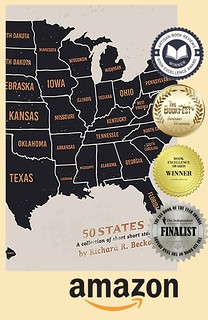
A few weeks ago, 50 States was honored with a 2023 Book Excellence Award. Out of thousands of books entered in this competition, 50 States was selected for its high-quality writing, design, and overall market appeal in the category of short stories. You can find its listing here.
This isn't the first award 50 States has earned. It won first place for short stories in the Spring 2022 BookFest Awards; first place in the ABR Book Excellence Award for literary fiction, psychological thriller, and short stories; and was named a finalist in the IAN Book Of The Year Awards.
Tuesday, January 31
Writing Stories: Stranger Than Fiction
There is a childhood punishment that the protagonist of my debut novel describes in my forthcoming debut novel. One of the beta readers didn’t like it. She called it silly, disbelieving it would ever happen.
The irony is that I borrowed it from real life. No, the novel isn’t real life. It’s a work of fiction. But as most writers will tell you, we all draw on real people or events, especially those that leave physical, emotional, or psychological imprints on our lives.
How else does one write straight, honest prose about human beings? Some of us look backward while writing forward, weaving the past into the present — even if we’re implanting the event on someone we made up, asking ourselves the whole time how the character might respond to it differently than we did. Sometimes they do. Sometimes they don’t.
This is where it can sometimes be tricky as a writer. We borrow bits of this and that from our lives and reshape them into something else for other people to experience until it isn’t our experience anymore, but someone else’s entirely, someone we made up. And this is why I sometimes offer a cautionary whisper to those who might remember actual events before they read my work. It’s not them or me or you or that or what happened, I tell them. Because, well, it isn’t any of that. Except in this case, maybe.
The childhood punishment I’m talking about really happened, and it happened to me. It was so real, in fact, I spent the better part of my twenties believing I deserved it, coping with it and other psychological abuses as a sort of joke. How bad of a kid was I? I was so bad …
When I finally had my own kids, I stopped telling the joke. It was no longer funny as I realized it was a punishment that I could never prescribe on my kids or any kids, for that matter. There wasn’t any infraction worthy of such a punishment or even the threat of it — which four more children endured while growing up until it became a thing of legend.
The punishment I’m talking about sounds familiar to most people. It was a room restriction, common enough that The Atlantic wrote about it like a rite of passage among previous generations. Some still argue that “grounding” can be effective. Maybe so. Except for mine, maybe.
My grounding wasn’t a weekend or week, as some might have experienced. It was a month, with the real caveat being that everything interesting was removed from my room — books, games, papers, pencils, etc. The circumstances didn’t make sense either, as it had very little to do with anything I did but a demonstration of unchecked authority. She had told me there would be consequences, so she had to follow up.
The consequence for putting one dish out of the dishwater away dirty was a month-long restriction. I didn’t doubt her. Past experiences had always convinced me she meant business. So I did what any preteen would do. I slowly, carefully, and meticulously inspected every dish while putting them away. And I felt true terror when she came in to inspect the work, slowing and randomly looking over glasses and plates and silverware.
I was so very careful, but it was there anyway. There was a water spot on one of the knives. The declaration of its finding was so fierce that it alone would have taught me a lesson, assuming there was one to teach. But it didn’t stop there, couldn’t stop there.
The consequence had already been outlined. I would be placed on room restriction for a summer month, only allowed out to use the bathroom and for meals.
I was so angry that it never occurred to me that I couldn’t see the offending water spot, nor could I discern whether it was the knife I had put away or some other that she had plucked from the drawer. What did occur, I learned later in life, is that she had triggered a fight or flight response, and I always tended to be a fighter.
I made a cavalier proclamation that I didn’t care about her punishment or authority. I would take my punishment like a champ, shut myself off from her wickedness, and read, draw, and play games until my vacation from her ended. Tut tut. Lay it on me.
That’s when she delivered what amounted to a left hook I never saw coming. She told me I was too smart for my own good, so all those things would be taken out of my room too. I would be left in there with nothing except my bed, clothes, and a window to look out of from the elevated first story of our apartment. It overlooked a pond.
Sometimes my son and daughter ask me what I did for that month. They are especially perplexed because, nowadays, a cell phone restriction can be more impactful than banishment to a room ever seemed to be. From what I remember, and I blanked a good part of it, I imagined things.
The protagonist in the novel, on the other hand, never says. He only mentions it as an illustration of circumstance, given the book isn’t about abuse. Any psychological abuse is only a subplot, a mechanism to help people understand the boy in relation to other events in the story.
Even so, I sometimes hope its presence in the story sparks conversation about it as it did with one of my beta readers. When people hear or talk about abuse, the word conjures images of physical or sexual abuse before emotional abuse or neglect, but those things exist too. And the wholesale destruction of someone’s self-worth carries consequences that take even longer to heal.
If you know of someone who needs help or if you need help yourself, Childhelp can put you in touch with local resources in your area. Aside from that, let’s have a conversation. Stories help people learn they are not alone, even when they sound stranger than fiction.
Friday, July 29
Breaking 1,000: 50 States, One Year Later
When 50 States was published last year, I didn't have the highest expectations. It's not that I didn't believe in the work. I did and do. But I'm also a realist who read some articles: self-published authors likely sell around 250 books or less; short story collections by small publishers sell between 300 and 2,000, about 1,000 for short story collections; and traditionally published authors sell around 3,000, a fraction of that for short story collections. All of these averages, by the way, are not considered spectacular.
Even more discouraging, the averages cited above are not one-year sales. These averages are based on the lifetime of the book — which some claim can be as short as six months, which is why some try to put out a new title every six months.
Right. Don't quit your day job.
Yes, there are exceptions. We've all heard stories of breakout debuts and bidding wars. But the general rule of thumb for authors is to temper expectations. Even Malcolm Gladwell's Tipping Point didn't find its tipping point until its third year (so much for that six-month lifetime theory). He just kept promoting it and promoting it and promoting it until he found an audience.
That's how I became a writer too.
I became a freelance writer in 1991 during a recession when nobody could hire a writer, but everybody had writing work. I didn't make enough money to pay the bills for the first two years writing advertising copy and articles, so I worked part-time matching colors in a paint store.
I specifically worked in a paint store 40 hours a week, Friday through Monday, so I could dedicate Tuesday through Thursday to establishing a career that became a company. It worked, but it took two years before I could comfortably cut the apron strings and pass on an offer to become an assistant manager mixing paint.
It wasn't until the third year that I had to hire more talent to help, the fifth year to incorporate, and the eighth before we expanded into publishing with more than 40 creatives working part time, full time, or stringing for Copywrite, Ink. It was a big wave, working on more than 1,000 accounts from startups to Fortune 500 companies. Then there came the point when I woke up from the 100-hour work weeks and realized I was managing (and teaching and serving my community) more than I was writing.
So, I sold some stuff and scaled way back. Nowadays, I only work with select clients and have a blast doing it.
How did I do it? Like anything.
You build a successful commercial writing career like you do any business: one job at a time. And knowing this, I always assumed you build a readership much the same way: one book at a time.
Never mind the setbacks or heartbreaks. Keep moving forward and find the people who appreciate the work. The successes will come in time. As long as you've written a decent book (or built a great product or created a great service), some measures of success will likely come back to you directly proportionate to the time and/or money you invest in it. At least I like to think so. It's the model I'm using now.
50 States Breaks 1,000. Ten Threads hits 500.
Selling 1,000 copies of 50 States in the first year and 500 copies of Ten Threads (Kindle exclusive) in two months seems like a solid baseline for a debut novel (and more short stories) that I intend to see published next year. It's on par with or better than traditional publishers, especially as I took in the learning curve.
I might also mention that 50 States didn't truly hit its stride until five or six months after publication. It became a Top 100 bestseller for three consecutive months in January of this year, not last year when I published it. It still does for a day or two, from time to time, demonstrating it has a lot of life left. And no, neither book has a 99 cents or $2.99 price point, although I have put them on sale occasionally.
Aside from sales, 50 States and Ten Threads have retained solid rankings and reviews. 50 States is 4.2 on Amazon and 4.3 on Goodreads. Ten Threads is rated 4.4 on Amazon and 4.5 on Goodreads.
50 States also won two awards: first place for short stories in the Spring 2022 BookFest Awards and first place for literary fiction, psychological thrillers, and short stories in the ABR Book Excellence Awards. InD’tale Magazine and OnlineBookClub.org also gave it top marks, giving it a "Crowned Heart" award and 4-star review, respectively.
Overall, both releases are beating the averages and have plenty of life left with a couple selling every day on slow days and bursts of sales on others. It reminds me that great things take about two years. I have one more to go.
Let's end with a few lessons learned.
I wouldn't have done it differently because a few life circumstances dictated my direction on the front end. However, here are six lessons learned that I'm happy to pass along.
• The best 'author' marketers aren't necessarily the best 'book' marketers. The publishing industry is loaded with pariahs that spend all their time marketing to authors and very little time selling the books, which is what they promise authors they will do. I won't out anyone here, but several top book marketing brands produced some of my lowest price points.
• The best 'book' marketers aren't cheap either. On the opposite end of the spectrum, authors are pitched by plenty of people who promise hundreds of thousands of impressions for ten or twenty bucks. I gave a few a shot as part of my learning curve. Lesson learned. Stick with mid-level, relatively affordable book marketers for the best price. Other than my own hustle, mid-level marketers produced my best results.
• Never pay for newswire distribution with major news affiliations. On two occasions, I was sold on the idea that book marketers or 'publicists' had magazine connections when all they really did was put a news release out on a newswire. If you're an author thinking about paying someone to do this, give me a call. I can write a better release for you and put it on the wire for you at a better price point. Egad.
• Kindle Unlimited (KU) is a double-edged sword. On one hand, it opens up a new audience. Conversely, some people who download your book might not be in your audience. If they post their lackluster review first, it can depress your initial sales. When this happened to Ten Threads, I looked up their other reviews and discovered my stories were well outside what they normally read. KU also means you receive a fraction of a penny per page, which doesn't come close to the actual sale price. It still has a place, so use KU sparingly for exposure but not on every title.
• Having worked with three primary distributors, I can safely say there is one route to take unless you plan to publish a children's book. Publishing with Ingram Spark and Amazon simultaneously will produce the best results. Simply put, Ingram Spark is your best bet to put quality books into bookstores, but expect the lion's share of your sales to come from Amazon. Maybe one day that will change in a creator economy, but it's probably a safe bet for the next two years or so.
• Last but not least, have as much patience as possible. Take some time to get advanced reader copies out to people before your release in exchange for feedback and a review before release. Along with that, put the presale date well ahead of your release. Early reviews will help book sales (even if I admit that I don't have the patience to wait). On the flip side, don't believe anyone who tells you the first month is critical or you will fail. It's important, sure, but you can still break the bestsellers list weeks or months or years after release. Books don't really have lifespans in my opinion, unless a publisher or author abandons them.
Hope these tips prove useful for future authors. And, equally important, if you were one of the thousands of people who bought 50 States or Ten Threads — thank you so very much! Here's to more books ahead!